Alone Over Bavaria: Black Thursday and the Price of Precision
"The day the Fortresses fell"
Alone Over Bavaria: Black Thursday and the Price of Precision
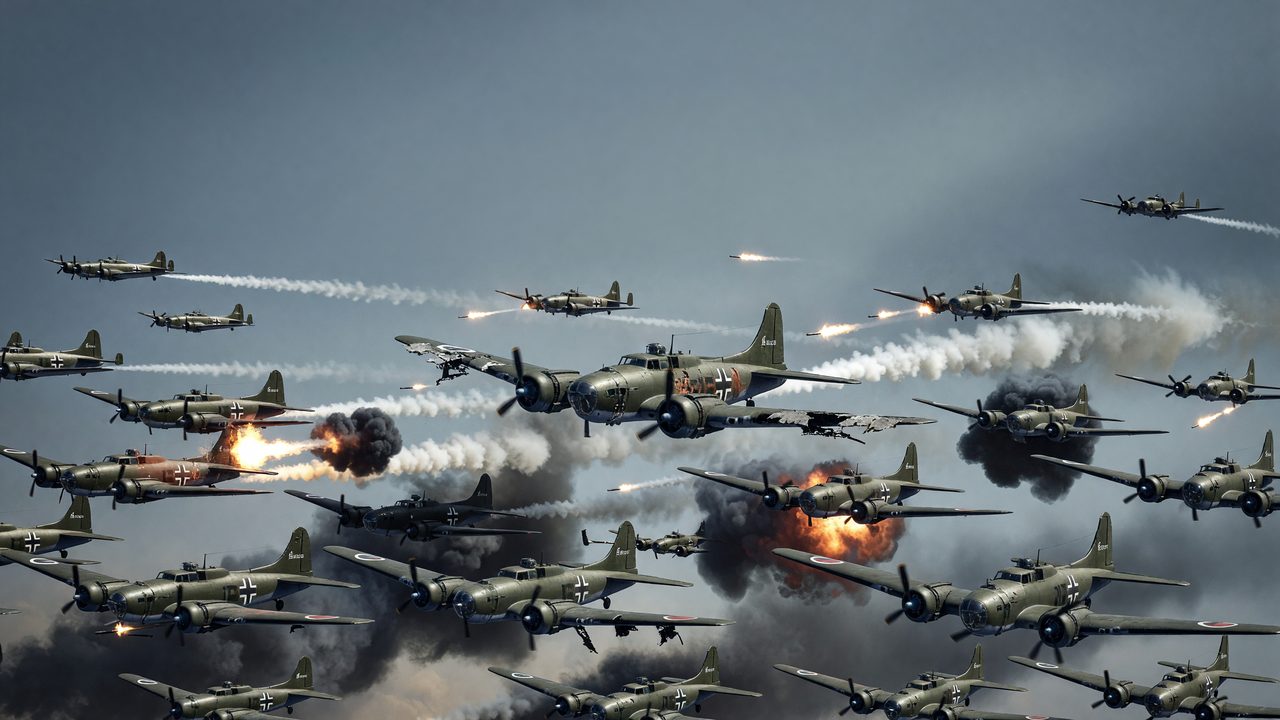
On 14 October 1943, nearly three hundred B-17s crossed into Germany without fighter cover—and the Eighth Air Force learned, in a single afternoon, that range is a weapon.
The Target That Could Not Wait
Schweinfurt sat at the center of Germany’s ball-bearing industry, the mechanical sinew of tanks, aircraft, and U-boats. American planners believed that smashing those factories could cripple the Reich’s war machine faster than any other single blow. Eighth Air Force commander Brig. Gen. Frederick Anderson told assembled crews before takeoff that the operation was “the most important air operation yet conducted in this war,” and that the target “must be destroyed.” His message was blunt: friends would be lost that day, and their sacrifice could not be wasted.
The mission was the second deep strike on Schweinfurt. A National Archives track chart from the August 17, 1943 raid—the first American deep-penetration bombing of the war—shows how carefully planners had already mapped routes to and from Bavaria. By October, the stakes were higher and the defenses thicker.
Into the Sky Without a Shield
The Eighth Air Force dispatched 291 B-17 Flying Fortresses in two divisions: 149 bombers in the First Air Division and 142 in the Third. Twenty-nine B-24 Liberators flew a diversionary mission to draw fighters away. P-47 Thunderbolts of the VIII Fighter Command escorted the formations through the penetration, but their fuel limits were unforgiving. When the Thunderbolts reached the German border and turned for home, the bombers were alone.
What met them was a Luftwaffe determined to defend its industrial heart. Crews from the 303rd Bomb Group, flying Combat Mission No. 78, reported roughly three hundred enemy fighters—Messerschmitts, Focke-Wulfs, and twin-engine attackers pressing attacks from the tail. Gunners encountered rocket-firing aircraft. Flak over Schweinfurt was moderate but accurate. Bombing ran at roughly 24,000 feet through seven hours and fifteen minutes of combat. Many crews dropped on target; post-mission estimates credited the strike with destroying perhaps three-quarters of Schweinfurt’s ball-bearing capacity. Dispersed German production and rapid repair, however, kept bearings flowing.
The Arithmetic of Disaster
The butcher’s bill arrived in waves. Sixty Fortresses went down over enemy territory. Seventeen more crashed or were scrapped after limping home. Another 121 returned so badly holed they would never fly combat again. Nearly 600 airmen were lost—594 listed missing in action in group records alone, with others killed or wounded. One 303rd crew, aboard Joan of Arc, was struck by a rocket from a Messerschmitt Me 210; the bomber went down near Bamberg with two men killed and nine taken prisoner.
Capt. James, a lead pilot in the 303rd, summarized the fight in a debrief still preserved in unit records: “As soon as our fighters left us, the German fighters came in and kept coming in until we got to the target and out again. They stayed for over an hour-and-a-half and were plenty eager.” Tail gunner-observer 1Lt. John C. Barker put it more plainly: “It was a hell of a day.”
A Doctrine Forged in Loss
Black Thursday fell at the climax of “Black Week,” a stretch from 8 to 14 October 1943 when weather and combat losses forced the Eighth Air Force to slow daylight strategic bombing. The shock was doctrinal, not merely statistical. Unescorted bombers, however tightly boxed, could not survive sustained fighter combat deep inside Germany. Deep penetrations beyond fighter escort were suspended until a fighter with the legs to go all the way arrived in force—the North American P-51 Mustang.
The raid did not end precision daylight bombing. It redefined what precision required: fighters that could stay with the bombers from coast to target and back.
Why it matters to you
Black Thursday is a case study in fuel, range, and mission design—the same variables you weigh on every cross-country or IFR flight plan. The P-47 was a superb fighter, but without adequate drop-tank capacity and doctrine to use it, escorts had to turn back at the border while bombers flew on into the killing ground. That failure reshaped USAAF thinking: fighters were no longer an optional luxury for penetration missions; they became the enabling technology for the entire bombing campaign. Engineers accelerated drop-tank production and integration; squadrons rewrote escort tactics around endurance rather than dash speed. When P-51s with external tanks finally escorted bombers to Berlin and back, they were answering a question Black Thursday had posed in blood.
For student and rated pilots alike, the lesson is operational, not historical. Range is not a footnote on the performance chart—it defines whether your wingman, your backup plan, or your entire mission survives the last hour. Plan fuel to the destination, the alternate, and the fight you did not expect. Know exactly where friendly support ends. The crews over Schweinfurt had none when they needed it most.