Above the Weather: The U-2 Dragon Lady
"Kelly Johnson promised the impossible in eight months. He delivered in nine."
Above the Weather: The U-2 Dragon Lady
Kelly Johnson’s jet-powered glider turned altitude into America’s first strategic eye in the sky—and never really came down.
A sketch that should not fly
In 1953, in a Lockheed office in Burbank, California, Clarence “Kelly” Johnson drew something that looked wrong on paper: a jet-powered sailplane. The Cold War demanded photographs of places no bomber could reach and no balloon could reliably overfly. Johnson’s answer borrowed the slender fuselage tooling of the F-104 Starfighter and mated it to long, lightly loaded wings more reminiscent of a competition glider than a military aircraft. The goal was brutal and precise—sustained cruise above 70,000 feet with roughly 3,000 miles of range, high enough that Soviet interceptors of the day could not reach it and low enough, ironically, that it still had to be an airplane rather than a satellite.
Johnson ran the program through Lockheed’s Advanced Development Projects—better known as the Skunk Works—where schedule was treated as a weapon. He promised twenty airframes in eight months. The first completed airplane arrived in nine. That slip measured in weeks, not years, and it astonished a government customer more accustomed to procurement measured in decades.
The CIA’s airplane
The Central Intelligence Agency, not the U.S. Air Force, became the U-2’s first customer. That bureaucratic choice shaped everything from cover stories to logistics. Official histories from the CIA’s Center for the Study of Intelligence describe a program born in secrecy: a reconnaissance platform that would photograph denied territory while its very existence remained classified. NASA’s developmental study Unlimited Horizons: Design and Development of the U-2 (NASA/SP-2015-565) documents how engineers chased weight, lift, and fuel fraction with monastic discipline. Every pound saved bought feet of altitude or miles of range. Cameras grew larger while the airframe grew spare.
The result was an aircraft that treated altitude as its armor. It carried no guns and relied on height rather than escort fighters for survival.
Groom Lake, August 1955
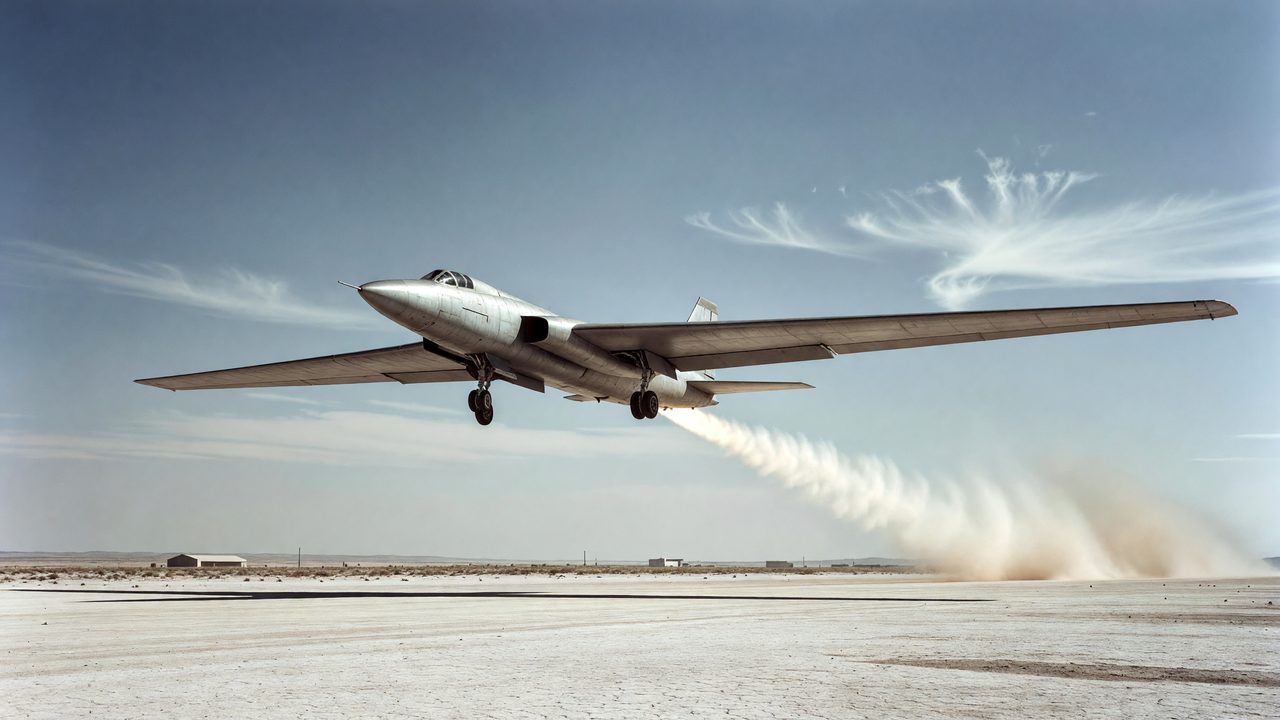
Flight testing moved to the remote Nevada test site later associated with Groom Lake. On 1 August 1955, Lockheed test pilot Tony LeVier was conducting a high-speed taxi evaluation when the U-2 lifted off unintentionally—an event Lockheed Martin’s official program history treats as the type’s practical birth. LeVier kept the airplane aloft, circled, and landed. The moment captured the machine’s temperament: gossamer on the ground, deceptively willing to fly when asked, and utterly dependent on a pilot’s fine control.
Early U-2s used a distinctive bicycle-style main gear and outrigger wheels that demanded wingtip-mounted “pogos” for ground stability. Takeoff and landing were not secondary skills; they were the sharp edge of the mission. At cruise, pilots worked in a partial-pressure suit against temperatures and pressures that turned ordinary airmanship into physiology management. The “coffin corner” was not classroom slang here but a daily neighbor—fly too slow and the long wing stalls; too fast and Mach limits on the thin airframe close in.
Audacity that aged into institution
What began as an emergency answer to a reconnaissance gap did not retire when satellites arrived. The Dragon Lady outlasted predictions because payloads, sensors, and human judgment still complement each other. Successive U-2 variants incorporated improved engines, avionics, and mission equipment, but the core idea remained Johnson’s: an engine, a pilot, a camera bay, and enough altitude to make distance meaningful. An airplane that first flew when jet travel was still novel remains operational in the twenty-first century—a rare case where a special-access prototype became a long-serving national asset.
For student and rated pilots studying performance, the U-2 is a lesson in trade studies made visible. It is not fast in the fighter sense. It is not agile. It wins by combining lift-to-drag ratio, power at altitude, and ruthless weight control—then asking a human to manage the narrow band where those virtues survive.
Why it matters to you
The U-2’s fuselage did not spring from a clean sheet. Kelly Johnson deliberately based it on the F-104 to save time, tooling, and production learning curve—an decision any pilot can recognize when stepping from one type rating into a related airframe that shares switches, systems logic, or handling cues. Modern training rewards that same transfer mindset: understanding why an airplane is shaped the way it is, not merely memorizing speeds and checklists. When you study performance charts, weight-and-balance limits, or high-altitude operations, you are practicing the same discipline that kept the Dragon Lady aloft—knowing which constraints are structural, which are aerodynamic, and which are human. Johnson reused the Starfighter’s fuselage to buy altitude for a mission nothing else could fly. Your job in the cockpit is smaller in scale but similar in spirit: spend the assets you have—airspeed, fuel, attention—so the airplane can do the one thing that matters on that flight.