A Thousand Meters of Discipline
"281 feet"
A Thousand Meters of Discipline
Before smoke trails and snap rolls, competition pilots learn to fly inside an invisible cube of air — and the rules written on paper have shaped aerobatic culture for generations.
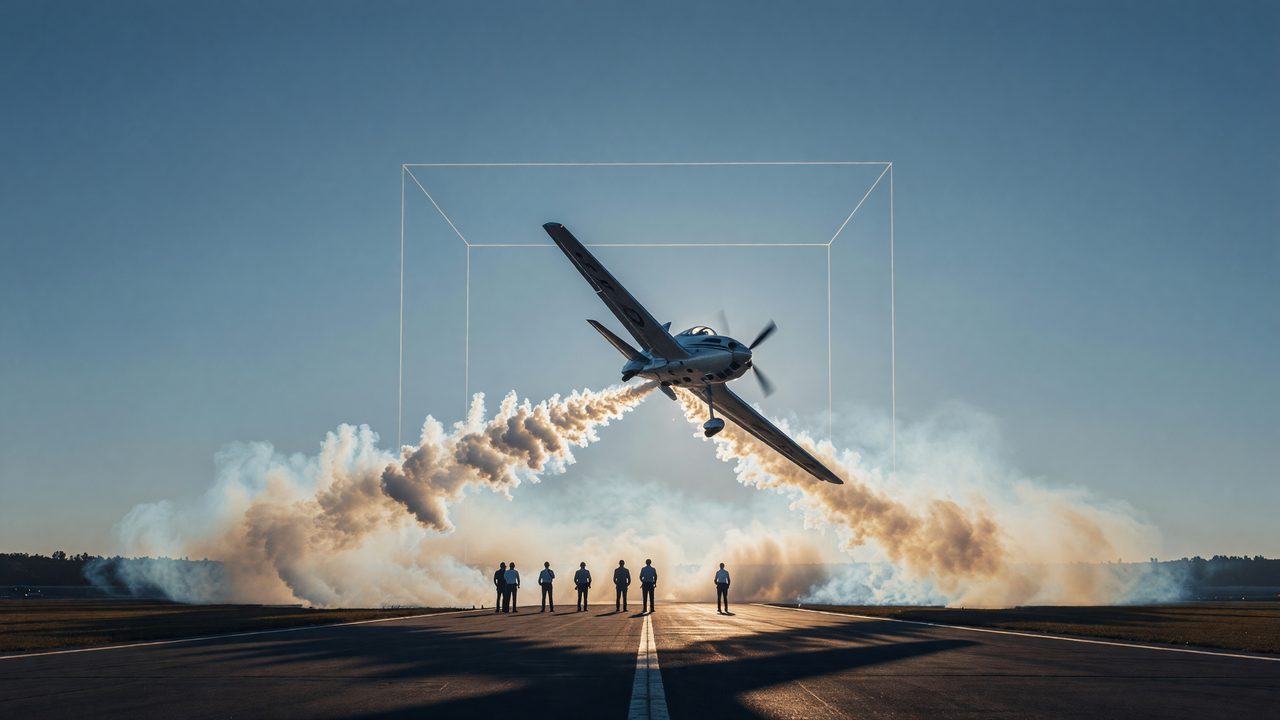
Stand on the edge of any sanctioned aerobatic contest and you will see nothing unusual: a grass runway, a line of judges squinting into the sun, perhaps colored panels staked in the turf. The arena itself is invisible. Yet every competitor knows exactly where it is. The aerobatic box is a precisely defined volume of sky — the stage on which international competition aerobatics has been performed since the mid-twentieth century, when postwar pilots began turning improvised airshow flourishes into a scored, repeatable sport governed by the Fédération Aéronautique Internationale.
The geometry of fair play
Under FAI rules administered by the Commission Internationale de Voltige Aérienne (CIVA), the competition box measures 1,000 meters long by 1,000 meters wide — roughly 3,281 feet on each horizontal axis. Its lower boundary for the Unlimited class sits at 100 meters above ground level, a floor that organizers treat as non-negotiable. The upper ceiling varies by category: Unlimited pilots may use the greatest vertical span, while Advanced and Intermediate competitors fly beneath lower altitudes that reflect both aircraft capability and safety margins. What does not vary is the lateral footprint or the sanctity of the base. Dip below the minimum altitude and a boundary judge will record an infringement that strips points from an otherwise flawless sequence.
British Aerobatics describes the box as nominally a cube of air with its lower face at 100 meters, though the effective height shrinks for classes below Unlimited. The International Aerobatic Club publishes the same dimensional standards for U.S. contests, illustrating how a single FAI template travels across national aerobatic organizations. Two ground axes define the space. The "A" axis aligns with the declared competition wind; the "B" axis runs perpendicular. Figures drawn in the Aresti notation must respect those orientations, because a loop flown downwind when the sequence calls for into-wind flight earns a zero — not a deduction, but annihilation.
When figures learned a common language
The box did not appear fully formed. It grew alongside the codification of aerobatic figures themselves. For decades, pilots and judges argued over what a "loop" or "hammerhead" actually looked like in the air. That ambiguity ended when CIVA adopted the Aresti Aerobatic Catalogue in 1987, making José Luis de Aresti's pictographic language the international standard for describing sequences. The FAI's published Aresti catalog and the Records of Amendments spanning 1987 through 2002 document how notation, judging criteria, and box protocols matured together. A pilot's card might call for a ½ Cuban eight on the cross-box axis; the judges' handbook defines how many degrees of axis error cost a point. The box supplies the spatial frame; Aresti supplies the choreography.
Eyes on the boundary
Judges sit in a line offset from the near edge of the box, typically between 100 and 250 meters back, where parallax and perspective allow them to grade figure shape, symmetry, and crispness. At major international events, electronic position-detection systems sometimes supplement human boundary judges, logging excursions beyond the box's vertical faces with automated precision. Whether the penalty comes from a handheld clicker or a transponder trace, the consequence is the same: boundary infringements subtract from the overall score, turning a moment of altitude inattention into a measurable competitive wound.
The discipline the box demands extends beyond altitude. Position penalties punish figures flown too close to the judges — where a loop's apex blocks the view — or too far downwind, where the aircraft shrinks to a speck. Wind correction becomes a quiet art: extending into wind between figures, shaving time downwind, accepting tiny heading deviations that judges cannot resolve at two and a half degrees. The box is not merely a safety envelope. It is a compositional frame, forcing pilots to present each figure where graders can see it clearly and where the aircraft still has room to recover.
Why it matters to you
You may never enter a CIVA-sanctioned contest or stake out box markers on a practice field. The lesson still belongs in your training. Every rated pilot operates inside invisible boundaries — minimum altitudes, airspace lines, obstacle clearance margins — and the aerobatic box distills that habit into its purest form. Long before a competition pilot lights the smoke system or rolls inverted, they have learned to respect a volume of air they cannot see but must feel: to scan altitude continuously, to plan energy so a maneuver finishes inside the envelope, to accept that precision is not showmanship alone but geometry obeyed under pressure. That respect for defined airspace, earned in a thousand-meter cube above a windy airfield, remains a cornerstone of aviation culture — and of the disciplined aviator you are becoming every time you choose to know exactly where you are in the sky.