When Wings Outmeasure the Field: Paul Allen’s Stratolaunch Roc
"385 feet"
When Wings Outmeasure the Field: Paul Allen’s Stratolaunch Roc
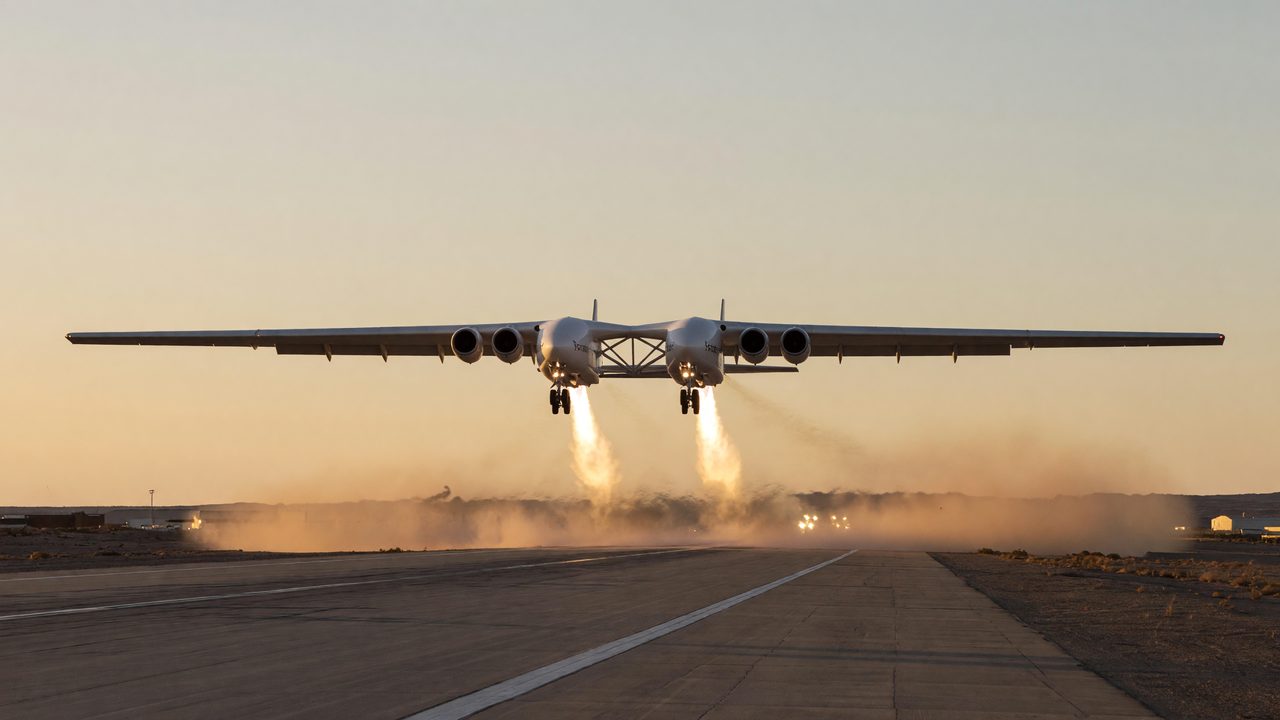
On a Mojave morning in 2019, six jet engines lifted an all-composite giant whose 385-foot span rewrote the record books—and carried a billionaire’s dream of airline-style access to orbit.
A Vision Born Outside the Government Ledger
Paul G. Allen did not wait for a federal appropriations cycle to chase space. The Microsoft co-founder established Stratolaunch Systems Corporation in 2011 with a premise that sounded almost casual in its ambition: make reaching orbit as routine as boarding a commercial flight. Rather than building bigger ground-launched rockets alone, Allen’s team would construct a flying launch pad—an aircraft that could carry rockets to altitude, giving satellites a head start in both height and velocity before ignition.
The engineering fell to Northrop Grumman’s Scaled Composites at Mojave Air and Space Port, the same desert crucible that had forged Burt Rutan’s experimental aircraft for decades. What emerged from the hangar was unlike anything in the civil or military fleet: a twin-fuselage, all-composite leviathan nicknamed Roc, powered by six Pratt & Whitney turbofans salvaged from the Boeing 747 lineage. Its reinforced center wing was designed to cradle launch vehicles weighing up to half a million pounds in total. Gross takeoff weight reached roughly 1.3 million pounds. Wingspan stretched 385 feet—longer than an American football field—while overall length measured 238 feet. By span alone, Roc displaced a record that had stood since 1947, when Howard Hughes’s H-4 Hercules, the Spruce Goose, made a single brief hop over Long Beach Harbor and never flew again.
Six Months After the Architect
Allen died in October 2018, six months before Roc would prove airworthy. His sister Jody Allen, chair of Vulcan Inc. and trustee of the Paul G. Allen Trust, watched from the Mojave ramp on 13 April 2019 as the aircraft that bore her brother’s imagination finally left the earth. When the six engines spooled up at 06:58 PDT, the world’s largest aircraft by wingspan began its maiden voyage over the California desert.
Chief executive Jean Floyd called it “a fantastic first flight.” Test pilot Evan Thomas, speaking to reporters afterward, said the experience was “fantastic” and that, for the most part, the airplane flew as predicted. Over two and a half hours, Roc climbed to 17,000 feet and reached a maximum speed of 189 miles per hour. The crew ran a disciplined first-flight profile: roll doublets, yawing maneuvers, pushovers and pull-ups, steady-heading sideslips, and simulated landing approaches as high as 15,000 feet mean sea level. The jet returned to the same Mojave runway and touched down without drama. Stratolaunch’s press release framed the achievement as validation of “a flexible alternative to ground launched systems.” Jody Allen’s statement was quieter and more personal: “We all know Paul would have been proud to witness today’s historic achievement.”
Anatomy of an Air-Launch Platform
To understand Roc as a pilot’s machine, set aside the space-launch mission for a moment and study its architecture. The dual-fuselage layout is not mere spectacle. Each fuselage carries its own cockpit and landing gear, but only the right-side crew station is occupied in normal operations; the left fuselage remains unpressurized and houses flight data systems. The two bodies join through a massive center wing section stiffened to bear the bending loads of suspended rockets. Six 747-derived turbofans provide the thrust needed to lift nearly 590 metric tons off a runway—enough mass to make Roc heavier than many aircraft yet still lighter, ton for ton, than the Antonov An-225, which Roc surpasses decisively in span.
The operational concept, as reported by the BBC and Stratolaunch, called for climbing to roughly 10 kilometers before releasing orbital payloads—an altitude and energy state that no ground-based pad can replicate without burning propellant to get there first. Whether carrying Northrop Grumman Pegasus XL rockets or, as later company plans once suggested, proprietary launch vehicles, Roc was designed to turn a runway into a spaceport. Spaceflight Now noted that the project’s early partnerships shifted over the years—SpaceX departed the concept in 2012, Orbital Sciences came and went—but the airframe itself remained the constant, a monument to private capital and composite manufacturing at a scale aviation had never attempted in the jet age.
A Record That Redefines “Large”
Coverage from Spaceflight Now and The War Zone placed Roc in its historical context immediately: the Hughes H-4’s 320-foot span had defined “largest wingspan” for seventy-two years, despite that aircraft’s solitary, low-altitude flight. Roc’s 2019 sortie was not a hop but a full test mission—two and a half hours of systems evaluation over the Mojave. The BBC’s reporting emphasized that while Roc claimed the wingspan crown, longer aircraft exist nose to tail; the distinction matters to engineers, who know that span drives structural load, ground handling, and wake behavior in ways length alone does not.
For pilots training in cockpits a fraction of Roc’s size, the flight still offers a lesson in proportion. An aircraft this wide demands coordinated rudder and aileron inputs through sideslip maneuvers—the very exercises Roc’s crew flew on day one. Its success affirmed that unconventional configurations, when flown methodically, can expand the envelope of the possible.
Why it matters to you
The engineering principles validated on Roc’s first flight—composite structures that save weight without sacrificing strength, redundant flight-control testing through deliberate sideslips and pitch excursions, and the discipline of treating an unfamiliar airframe with conservative altitude and speed targets—are embedded in the aircraft you fly today. Your trainer may not span a football field, but every preflight weight-and-balance calculation, every slow-flight clearance of the rudder, and every approach flown by the numbers reflects the same physics Roc’s crew proved over the Mojave: structure must carry the load, controls must be calibrated before trust is earned, and the first flight of anything extraordinary is won through method, not bravado. When you next practice a steady-heading sideslip to a landing, you are rehearsing a maneuver that once certified the largest wingspan ever to leave the ground.