When the Sky Went Quiet: How AF447 Rewrote Ocean Search and Pilot Training
"Ice blocked three pitot tubes. The crew did the exact wrong thing for three and a half minutes. Two hundred and twenty-eight people fell from the sky."
When the Sky Went Quiet: How AF447 Rewrote Ocean Search and Pilot Training
On a stormy June night over the Atlantic, unreliable airspeed and a deep stall sent 228 people into the sea—and nearly two years passed before investigators could explain why.
Shortly after 02:00 coordinated universal time on June 1, 2009, Air France Flight 447—an Airbus A330-203 registered F-GZCP, bound from Rio de Janeiro to Paris with 228 people aboard—entered a band of towering cumulonimbus near the Intertropical Convergence Zone. Supercooled water droplets accreted on the aircraft’s pitot probes, temporarily blocking the pressure ports that feed airspeed to the flight computers. The measured speeds became inconsistent. The autopilot disconnected automatically, and the fly-by-wire system reconfigured into alternate law, leaving the two first officers on the flight deck to hand-fly an airplane at flight level 350 in turbulence and darkness while the captain rested in the crew bunk.
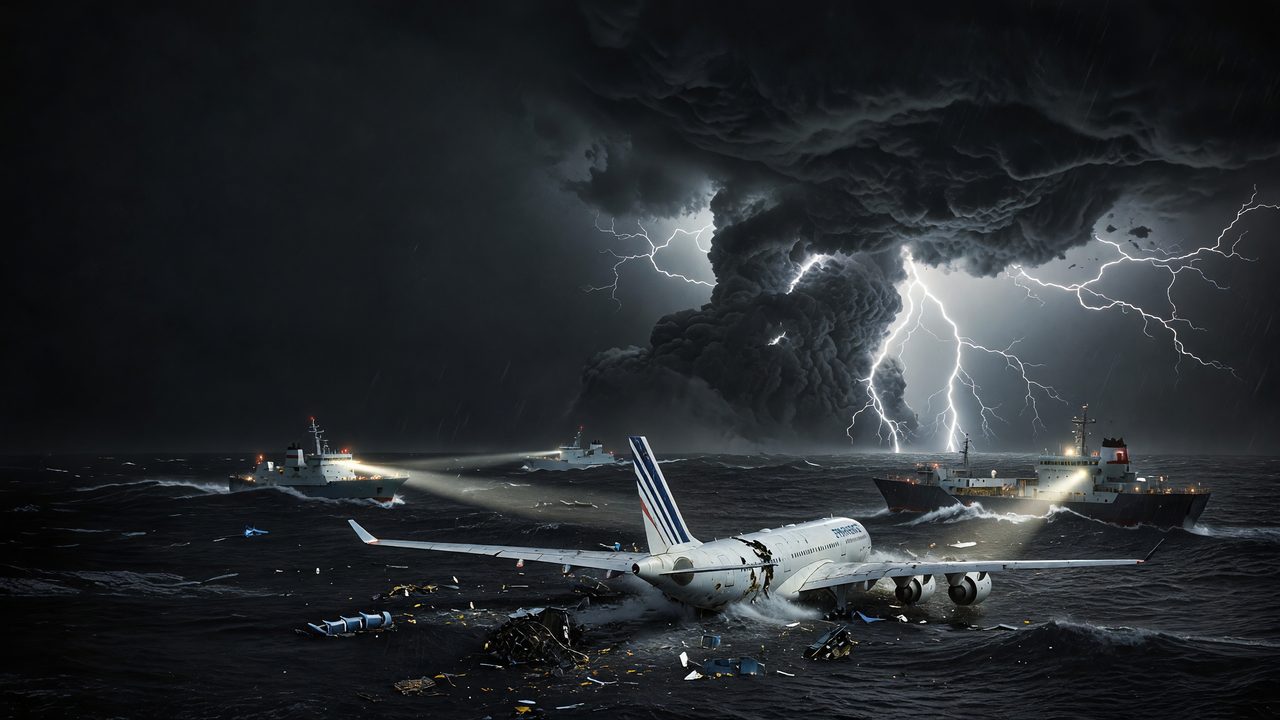
What followed was not a sudden structural breakup but a prolonged aerodynamic failure. According to the French Bureau d’Enquêtes et d’Analyses (BEA) final report, the pilot flying applied sustained nose-up sidestick inputs. The angle of attack increased. Stall warnings sounded—yet the crew did not execute the fundamental recovery: reduce angle of attack by lowering the nose. Instead, the A330 entered a deep stall from roughly 38,000 feet and descended for approximately three minutes and thirty seconds before striking the ocean at about 107 knots. The impact was survivable for no one. Surface searchers found only scattered debris and fuel slicks. The main wreckage, and the answers locked inside it, lay on the seabed nearly four kilometers down.
The recorders tell a story training had not prepared anyone to hear
Recovery of the cockpit voice recorder and flight data recorder in April 2011—after one of the most arduous undersea searches in aviation history—transformed AF447 from mystery to case study. The BEA’s reconstruction showed a cockpit struggling to reconcile contradictory cues. With pitot icing corrupting airspeed, the crew lacked a clear, continuous display of the inconsistency the computers had already detected. The stall warning logic itself became part of the trap: when computed airspeed fell below a threshold, the warning could cease even as the aircraft remained deeply stalled, because the software tied the alert to airspeed validity. The A330’s primary flight display offered pitch, bank, altitude, and airspeed—but no angle-of-attack indicator to show how close the wing was to its critical angle. Warnings blared; the instruments, in combination, did not tell a single coherent story.
Task sharing fractured under startle. The less experienced first officer held the controls while the other pilot called for checklists and tried to diagnose a “flight path” problem rather than a stall. The BEA concluded that the crew had not been trained for high-altitude manual handling after speed anomalies, nor for recognizing and recovering from an approach to stall at cruise altitude—regimes far removed from the low-altitude stall demonstrations most pilots memorize.
A search that refused to quit
The first ocean searches after June 2009 swept vast swaths of mid-Atlantic bottom and found almost nothing useful. The underwater phase that succeeded in 2011 was privately funded and guided by Bayesian analysis. Metron, a U.S. scientific consultancy, re-examined drift models, sonar contacts, and debris paths to refine probability maps of where the wreckage might lie. Autonomous underwater vehicles, operating at depths near 3,900 meters—about 12,800 feet—finally photographed the fuselage and retrieved the recorders. The BEA’s subsequent work on improving the location of transoceanic flights that disappear at sea documented how AF447’s five search phases, spanning two years and tens of millions of euros, exposed gaps in underwater locator beacon endurance, low-frequency homing, and the slow choreography of mounting a deep-ocean hunt. Recommendations flowed to the International Civil Aviation Organization and the European Union Aviation Safety Agency: longer-lasting beacons, structural low-frequency transmitters, triggered transmission of flight data, and the longer-term Global Aeronautical Distress and Safety System concept. An accident that began with ice on three small tubes ended by reshaping how the world looks for airplanes that vanish over water.
Ripples in every syllabus
Regulators and operators worldwide reacted. Thales AA pitot tubes, susceptible to icing at altitude, were replaced fleet-wide with more robust designs. Training syllabi gained emphasis on unreliable-airspeed procedures, manual flying at high altitude, and upset prevention and recovery—teaching pilots to prioritize angle of attack and known pitch-power settings when airspeed cannot be trusted. Airbus and other manufacturers faced renewed scrutiny of how human factors and software logic interact when sensors fail.
Why it matters to you
AF447’s crew received stall warnings yet held the nose up—the opposite of correct stall recovery—because conflicting instrument indications, the absence of a dedicated angle-of-attack display, and inadequate high-altitude upset training combined into a fatal cognitive trap. When airspeed becomes untrustworthy, the brain reaches for the gauge it has always trusted; when stall logic depends on that same corrupted data, warnings can lie or fall silent at the worst moment. Modern upset-recovery training asks you to break that loop early: recognize the stall by attitude and buffet, unload the wing first, then sort out airspeed. AF447 is not ancient history. It is the accident that taught the world to search deeper, record smarter, and train pilots to believe the wing when the instruments disagree.