When the Certificate Had No Cockpit
"000 days"
When the Certificate Had No Cockpit
On a Friday in October 2023, China’s civil aviation authority approved the world’s first type-certified passenger aircraft designed to fly itself—and in doing so, sketched a regulatory map for urban air mobility that the rest of the industry is still trying to follow.
A Friday That Changed the Rules
Late on the afternoon of 13 October 2023, the Civil Aviation Administration of China (CAAC) issued a type certificate that aviation regulators had never before been asked to contemplate. Guangzhou-based EHang received approval for its EH216-S—a two-seat electric vertical take-off and landing (eVTOL) aircraft intended to carry paying passengers with no pilot on board.
A type certificate is the formal declaration that an aircraft design meets the safety standards required for commercial operation. For more than a century, those standards had assumed a human at the controls. The EH216-S broke that assumption. According to EHang’s announcement that day, the aircraft was authorised for fully autonomous commercial air taxi service, supervised from the ground rather than flown from a cockpit.
The news rippled quickly through the industry. As CNBC reported on 13 October, China had cleared EHang to operate fully autonomous, passenger-carrying air taxis—a milestone no other national authority had yet matched for an unmanned eVTOL.
From CES Booth to Certified Aircraft
The path to that certificate began years earlier, in a very different setting. At the Consumer Electronics Show in Las Vegas on 6 January 2016, EHang unveiled the EHang 184—a single-seat autonomous aerial vehicle that looked less like traditional aviation and more like a flying appliance. The concept was bold: passengers would enter, select a destination, and let the aircraft handle the rest.
What followed was not a publicity stunt but a sustained engineering and flight-test programme. EHang reported that its autonomous aerial vehicles had been flying since 2017, accumulating tens of thousands of test flights as engineers refined propulsion, redundancy, navigation, and the ground-based command architecture that would eventually replace an onboard pilot.
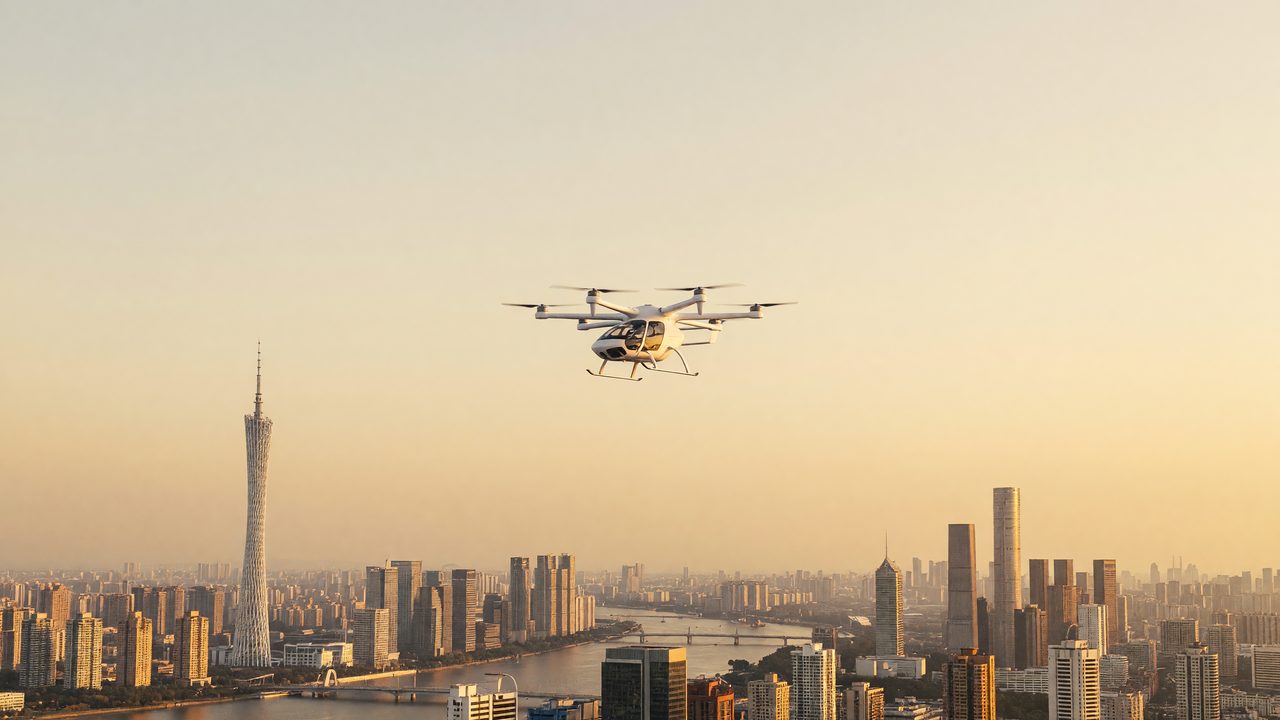
The EH216-S that earned certification in 2023 evolved from that lineage. It is an octocopter—eight rotors arranged to provide lift and control in the vertical-flight regime—with seating for two. Flight commands originate at a central command centre; remote monitoring provides supervisory oversight rather than stick-and-rudder inputs. Demonstration flights have since been conducted across eighteen countries, from tourist corridors over Dubai to urban connections within China’s growing city networks.
More Than a Thousand Days of Scrutiny
CAAC’s approval did not arrive quickly. EHang stated that certification required more than 1,000 days of rigorous testing—roughly three years of structural analysis, systems validation, operational trials, and the slow, painstaking work of proving that an algorithm could match the safety case regulators traditionally assigned to a trained human pilot.
Crucially, the authority also published special conditions tailored to unmanned passenger vehicles. Where existing airworthiness codes assumed a pilot who could intervene, regulators had to define new expectations: how autonomy must detect and recover from faults, how ground supervision must function, and what evidence proves the system is safe when no one aboard can take over manually.
New Atlas, reporting on 15 October 2023, framed the achievement plainly: the world’s first type-certified eVTOL was ready for service. For the urban air mobility (UAM) industry—a field crowded with renderings and venture capital but thin on certified hardware—that distinction mattered. EHang had established a regulatory benchmark others would study, adapt, or challenge.
Hail a Ride, Not a Pilot
The operational vision is deliberately mundane. Proponents want the public to summon an air taxi as easily as a car ride—an app, a pad, a short hop over traffic-choked streets. EHang’s certification suggested that vision need not depend on a pilot shortage solution or a hybrid “safety pilot” crutch. The aircraft could be navigated by algorithms, with humans watching from afar.
That does not make the skies empty of human judgment. It relocates it—to dispatchers, engineers, airspace managers, and the regulators who must keep pace with software updates. But it does open a chapter in which certified passenger flight no longer requires someone in the left seat.
Why it matters to you
You may never fly an EH216-S. Most certificated pilots never will. Yet the engineering principles CAAC scrutinised for more than a thousand days—layered redundancy, deterministic failure modes, human–automation teaming, and the discipline of proving a system safe before it carries souls—are already embedded in the aircraft you fly today. Glass-cockpit transports, coupled autopilots, envelope protection, and satellite-guided approaches all reflect the same question EHang forced into the open: who, or what, is actually flying?
For student and rated pilots, that question is not academic. Every time you brief an autopilot mode, cross-check a GPS track, or hand-fly when the automation’s logic does not match the real weather, you are practising the judgment that regulators now demand from machines. Urban air mobility will press those skills further—denser airspace, shorter flights, higher tempo. EHang’s October 2023 certificate did not replace the pilot in the traditional cockpit. It reminded every pilot that certification, supervision, and situational awareness remain the spine of safe flight—whether the “crew” is two people in shirtsleeves or a room full of screens watching an octocopter climb above Guangzhou.