When the Center Tank Blew: How TWA 800 Rewrote Fuel-Tank Certification
"230 souls. One spark in a fuel tank. A certification assumption that cost everything."
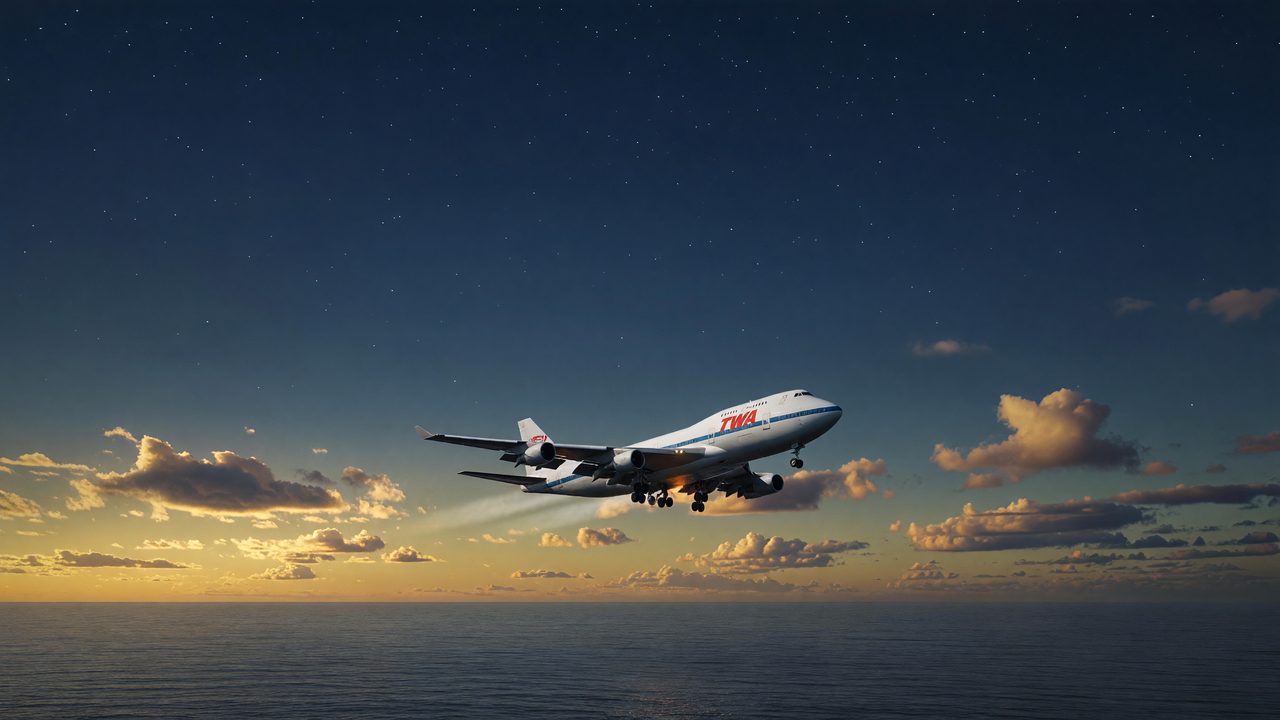
When the Center Tank Blew: How TWA 800 Rewrote Fuel-Tank Certification
On a summer evening climb out of Kennedy, a Boeing 747’s empty center wing fuel tank exploded—and the investigation that followed forced aviation to stop betting that ignition sources alone could keep tanks safe.
Twelve minutes into the Atlantic night
On July 17, 1996, Trans World Airlines Flight 800, a Boeing 747-131 registered N93119, lifted off from John F. Kennedy International Airport bound for Charles de Gaulle Airport in Paris. The flight carried 212 passengers and 18 crew members under Part 121 on an instrument flight plan in visual conditions. It departed about 8:19 p.m. Eastern Daylight Time. Roughly twelve minutes later, about 8:31 p.m., the airplane broke apart over the Atlantic Ocean near East Moriches, New York. All 230 people aboard were killed, and the aircraft was destroyed.
Witnesses along the Long Island coast saw a fireball bloom against the dusk sky. Fishermen and beachgoers heard the concussion. Within hours, the search became one of the largest recovery operations in NTSB history. Investigators eventually reconstructed the wreckage in a hangar, piecing the 747 back together fragment by fragment to read the story written in bent metal and scorched wiring.
What the wreckage said
The National Transportation Safety Board’s Aircraft Accident Report, published as NTSB/AAR-00/03, In-flight Breakup Over the Atlantic Ocean, Trans World Airlines Flight 800, concluded that the probable cause was an explosion of the center wing fuel tank (CWT). Flammable fuel-air vapors inside the tank ignited. The ignition energy source was never established with certainty. Among the scenarios the Board evaluated, the most likely involved a short circuit outside the CWT that introduced excessive voltage into wiring associated with the Fuel Quantity Indication System (FQIS).
The breakup was not a single event but a sequence. The initial blast fractured the tank structure and severed critical systems. Aerodynamic loads then tore the fuselage apart. The investigation’s painstaking reconstruction showed where the explosion originated and how the airplane came apart in the sky.
A certification philosophy that failed
Two contributing factors pointed beyond any single wire or switch. First, the industry’s design and certification approach had assumed that fuel tank explosions could be prevented by eliminating ignition sources alone—treating the tank’s vapor space as safe so long as nothing sparked inside it. Second, the Boeing 747 placed air-conditioning packs beneath the CWT without adequate means to limit heat transfer into the tank or to keep vapors below flammability limits.
On a hot July evening, those assumptions converged. The CWT on Flight 800 was largely empty, holding only residual fuel. Empty tanks contain more ullage—the vapor space above the fuel—and on a long ground delay in summer heat, the air-conditioning machinery below had been warming that space for hours. By the time the 747 climbed away from JFK, the Board found, the tank held a flammable mixture. Certification had treated ignition prevention as sufficient. Flight 800 proved it was not.
From recommendations to regulation
The NTSB issued sweeping recommendations to the Federal Aviation Administration, many aimed directly at fuel tanks and the wiring that serves them. The Board urged design or operational changes to prevent transport-category airplanes from flying with explosive fuel-air mixtures in tanks. It called for consideration of nitrogen inerting, insulation between heat sources and tanks, revised operating procedures for 747 center tanks, temperature monitoring, FQIS wiring separation and shielding, surge protection, and broader aging-aircraft wiring reforms.
The FAA’s Lessons Learned entry for N93119 documents how the accident reshaped policy. The agency moved beyond the old ignition-only model toward managing flammability itself—reducing heat input, limiting time spent with volatile ullage, and eventually requiring flammability reduction means on affected fleets. Special Federal Aviation Regulation 88, issued in 2001, mandated design changes for certain transport airplanes. Later rulemaking advanced fuel tank flammability standards and nitrogen inerting for the center wing tanks of large U.S.-operated jets. TWA 800 did not merely close one case file. It reopened how certificated airplanes were allowed to carry fuel vapor next to heat.
Why it matters to you
The legacy of that July evening still reaches the cockpit you train in today. Modern fuel-system instruction is not only about quantity, balance, and crossfeed—it is about ullage, heat-soak, and the reality that an empty tank can be more hazardous than a full one on a hot ramp. When you study fuel management, MEL items on FQIS components, or airline procedures that discourage long ground delays with heated center tanks, you are applying lessons bought at terrible cost. TWA Flight 800 broke apart in mid-air minutes after a routine departure; the certification world it changed now expects you to understand fuel not merely as ballast and range, but as a thermodynamic system whose vapor space demands respect long before anyone searches for a spark.