When the Army Expected Them to Fail
"They had to be better to get the same chance."
When the Army Expected Them to Fail
In 1941, the U.S. Army Air Corps bet that Black Americans could not master combat aviation. The pilots trained at Tuskegee, Alabama, spent the rest of the war proving the institution wrong — and rewriting how fighter escorts were flown.
An Experiment Designed to Collapse
The Tuskegee program did not begin as a gesture of inclusion. It grew from federal legislation and wartime necessity — the Civilian Pilot Training Act of 1939, the Selective Service Act of 1940, and a War Department decision to develop what it called "colored personnel" for aviation service, as documented by Tuskegee Airmen Inc. in "The Story." When the Army Air Corps activated its first all-Black flying unit in 1941, the training pipeline at Tuskegee Institute and Moton Field was segregated by design. Black cadets ate alone, trained apart, and flew aircraft that were often older and less capable than those issued to white units.
Many senior officers treated the program as a trial they expected to fail. Cadets who washed out made headlines; those who succeeded were scrutinized twice as hard. According to the National Air and Space Museum's account of the Tuskegee Airmen, some commanders openly worked against the unit's success. The pressure forged a culture of precision. As future Detroit mayor Coleman Young, himself a Tuskegee Airman, later put it: "They made the standards so high, we actually became an elite group."
The Leader Who Refused to Buckle
No one embodied that discipline more than Benjamin O. Davis Jr. At West Point, where he entered in 1932, Davis endured four years of deliberate silence. White cadets would not speak to him; he took meals alone rather than bend. He graduated in 1936 in the top fifth of his class — the fourth African American to earn a West Point commission. When the Air Corps finally opened pilot training at Tuskegee in July 1941, Davis was among the first 13 cadets in that inaugural class. He earned his wings in March 1942, commanded the 99th Fighter Squadron in combat over North Africa and Italy, then returned stateside to defend his men against Pentagon accusations of poor performance before assuming command of the 332nd Fighter Group.
Red Tails Over Europe
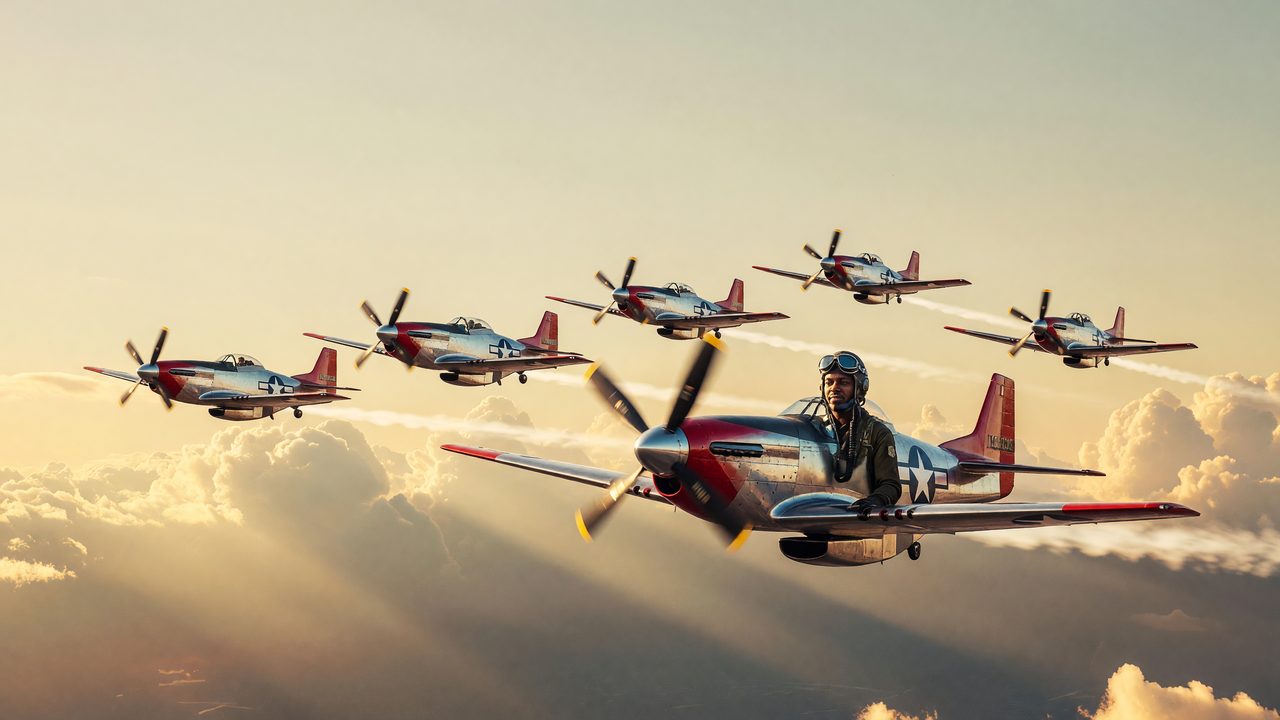
The 332nd Fighter Group — the 99th, 100th, 301st, and 302nd Squadrons — became the bomber escort unit the Fifteenth Air Force could not do without. Flying P-51 Mustangs with distinctive crimson tail markings, the "Red Tails" protected B-17 and B-24 formations on deep strikes into Germany and Austria. Tuskegee University's "Tuskegee Airmen Facts" records that the group achieved one of the lowest bomber loss rates among Fifteenth Air Force escort units, a record unmatched by peer fighter groups. On March 24, 1945, during the group's longest escort mission to Berlin, pilots destroyed three German Me 262 jet fighters and damaged five more — earning a Presidential Unit Citation.
Davis, who led the 332nd in Europe, stated plainly that escort was the group's prime mission and that they carried it out without losing a bomber to enemy fighters. The claim invited skepticism then and debate among historians since, but the operational record stands: bomber crews requested Red Tail escorts by name, and enemy pilots often declined to press attacks against formations they protected.
A Legacy That Outlasted the War
The Tuskegee Airmen's influence extended far beyond their combat scores. Charles McGee, who flew 137 missions with the 332nd in Italy, went on to complete 100 combat missions in Korea and 172 in Vietnam — 409 in all across three wars, according to National Air and Space Museum biographical records. Davis rose through the integrated Air Force that the Airmen helped make conceivable, becoming its first Black general officer and, decades later, receiving a fourth star. President Harry Truman's Executive Order 9981 in 1948, mandating equal treatment across the armed forces, did not end racism overnight, but it closed the legal architecture of segregation that had kept the Red Tails separate in the first place.
Why it matters to you
When you practice formation flying, maintain escort position, or rehearse defensive tactics against an unseen threat, you are training in a tradition the 332nd refined under impossible scrutiny. Because every mistake risked the program's cancellation, Tuskegee pilots held station tighter, briefed longer, and stayed with their bombers when other escort groups peeled off to chase victories. Those habits — disciplined formation integrity, mutual support, mission-over-kill — spread through Fifteenth Air Force doctrine and remain embedded in how fighter and military training programs teach escort and section tactics today. Excellence, the Red Tails demonstrated, is not the property of any single background. It is built flight by flight, under standard or under pressure, by pilots who refuse to leave the formation.