When Silence Earned a Type Certificate
"50 minutes"
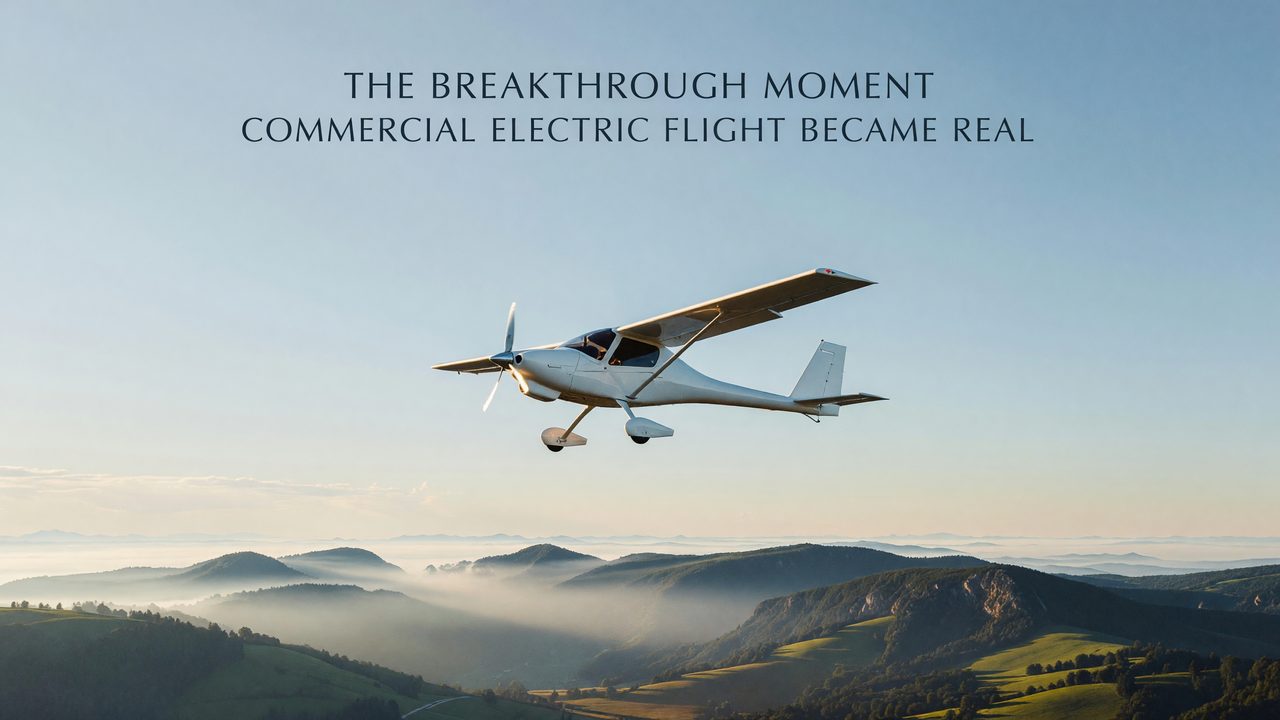
When Silence Earned a Type Certificate
On a June morning in 2020, a Slovenian two-seater crossed the threshold that electric aviation had chased for a century: full regulatory approval for commercial flight.
For most of aviation history, battery-powered aircraft lived at the margins. They appeared at airshows as one-off experiments, university testbeds, or homebuilt curiosities—impressive demonstrations that stopped short of the paperwork, flight testing, and engineering discipline that define certified aviation. Fossil-fuelled trainers and commuters carried the weight of regulation; electric prototypes carried the weight of skepticism. That division held until 10 June 2020, when the European Union Aviation Safety Agency issued a type certificate to the Pipistrel Velis Electro, a two-seat trainer developed in Ajdovščina, Slovenia. EASA’s announcement marked the first worldwide type certification of a fully electric aircraft—an aircraft cleared not merely to fly, but to operate within the same commercial framework as conventionally powered machines.
A Trainer Built for the Pattern
Pipistrel had spent years refining energy-efficient light aircraft from its Slovenian workshops, and the Velis Electro arrived as a deliberate training platform rather than a technology demonstrator. Certified as Model Virus SW 128, it joined a product line that already included similar conventionally powered trainers, allowing flight schools to fold electric operations into familiar syllabi. With a 58 kW liquid-cooled motor and a maximum take-off weight of 600 kg, the aircraft was sized for the circuit: quiet, emission-free hops of up to roughly fifty minutes—enough for touch-and-goes, stalls, and the repetitive manoeuvres that build a private pilot’s muscle memory. EASA described the Velis Electro as intended primarily for pilot training, and that mission shaped every certification decision that followed.
The Engine That Had to Come First
No aircraft earns a type certificate without a certified powerplant, and electric propulsion had never cleared that bar. On 18 May 2020—just weeks before the airframe approval—EASA certified the Pipistrel E-811, the first electric aero-engine to receive regulatory approval. Designated E-811-268MVLC in certification documents, it gave the Velis Electro a legally recognised propulsion system with defined limits, failure modes, and maintenance requirements. Certifying the engine separately established a precedent regulators would revisit again and again: battery-electric flight is not a single invention but a stack of interdependent systems—motor, inverter, battery management, thermal control—each of which must meet the same evidentiary standard as a Lycoming or Rotax.
Three Years of Cooperative Flight Testing
EASA completed the Velis Electro certification in under three years, a timeline agency officials credited to sustained cooperation between Pipistrel and the regulator. Rather than treating electric propulsion as an exception, both parties applied existing airworthiness logic to unfamiliar hardware. EASA pursued what it later described as a two-stream approach: conventional certification activities for the aircraft itself, run in parallel with a coordinated flight-test programme using a fleet of non-certified Alpha-Electro aircraft operating under EASA permits to fly. That fleet supplied operational data the certification team needed while revealing the ground-support realities of electric aviation—charging intervals, battery monitoring, and the logistics of keeping training aircraft available between sorties. Through the process, EASA gained direct experience with lithium-based energy storage, battery management systems, and electrical engine power units—knowledge that would inform every electric and hybrid project that followed.
A Template for Everything After
EASA Executive Director Patrick Ky called the Velis Electro certification “an exciting breakthrough,” adding that it would “certainly not be the last” as the industry pursued quieter, lower-emission aircraft. He was right. The Velis Electro did not solve electric aviation’s endurance problem overnight, but it proved something regulators and manufacturers had only theorised: a battery-powered aeroplane could satisfy the same safety bar as its fossil-fuelled forebears. The project delivered what EASA termed important learnings for future certifications of electrically powered engines and aircraft, and the agency’s own topic page on the milestone frames the Velis Electro as a steppingstone toward hybrid configurations that pair piston and electric units. From urban air taxis to regional commuters, nearly every electric programme now underway inherits the regulatory grammar written first for a quiet trainer over Slovenia.
Why it matters to you
You may never hand-fly a Velis Electro, but the engineering discipline behind its certification is already part of how modern pilots are trained to think. Energy management—once the concern only of glider pilots watching sink rates—is now a systems concept every aviator should understand, whether the electrons drive a motor or the fuel feeds a combustion chamber. Battery monitoring, thermal limits, and defined power envelopes mirror the powerplant limitation awareness you apply when leaning mixture or respecting maximum continuous power. The Velis Electro also reminds student and rated pilots alike that type certificates are living evidence: every aircraft in your logbook exists because someone proved its systems, documented its failures, and convinced a regulator the risk was acceptable. Electric aviation did not rewrite that contract in 2020. It fulfilled it—and in doing so, gave you a clearer picture of where flight training, and the aircraft you fly today, are headed next.