When Giants Kneel: The C-5 Galaxy and the An-124 Ruslan
"One carries 130 tons. The other carries 150. Neither has ever met a load too large."
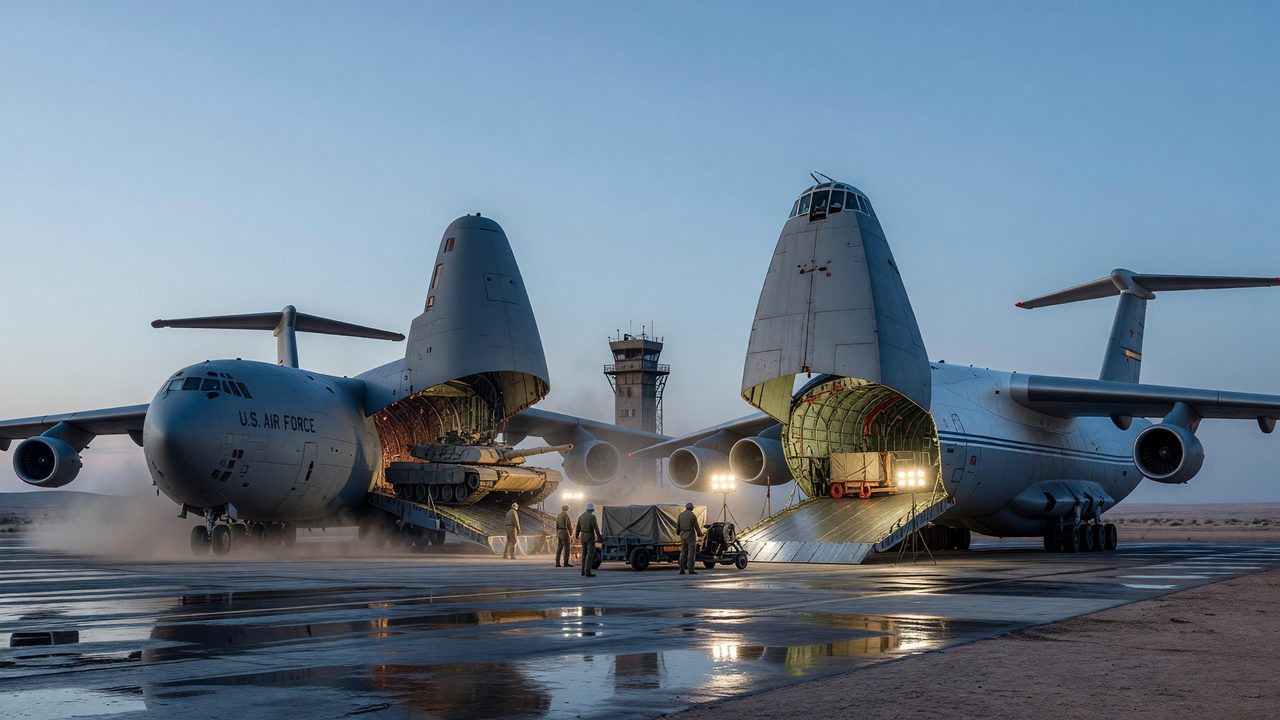
When Giants Kneel: The C-5 Galaxy and the An-124 Ruslan
Two Cold War leviathans built to move armies across continents now share the same charter ramps—and teach pilots what “heavy” really means.
On the morning of 30 June 1968, a new silhouette lifted from the runway at Lockheed’s Lockheed-Georgia plant at Dobbins AFB in Marietta, Georgia, flown by test pilot Leo Sullivan. The Lockheed C-5 Galaxy was not merely large; it was conceived as a flying warehouse for an Air Force that had learned, painfully, that global power projection begins with what you can put on the ground and how fast you can get it there. Entering operational service in 1970, the Galaxy could swallow payloads up to 130 tons—main battle tanks, helicopters, and even smaller aircraft whole—through a nose that hinged upward and a tail ramp that dropped to the earth. For half a century it has remained the largest military transport in the Western world, the physical expression of an American doctrine built around rapid, worldwide deployment.
That doctrine did not stand still. By the 2000s, the original TF39 turbofans that had powered the first Galaxies were showing their age. The C-5M Super Galaxy modernization program, completed in 2018 according to U.S. Air Force records, replaced those engines with General Electric CF6-80C2 turbofans and refreshed avionics and structures across the fleet. The Air Force now projects service life into 2040 and beyond—a remarkable second act for an airframe whose cavernous hold still defines strategic airlift. The upgrade was more than incremental. On 15 September 2009, a C-5M departing Dover Air Force Base, Delaware, climbed into the record books: Lockheed Martin and the National Aeronautic Association later documented 41 world records for heavy-lift aviation set in a single flight, spanning altitude with payload, time-to-climb, and sheer mass moved through the sky. The message was unmistakable. Strategic airlift remains the backbone of American global reach, and the Galaxy, reborn, could still outlift almost everything else wearing military gray.
While American engineers were stretching the limits of deployment speed, Soviet designers were answering a parallel question with a different emphasis: how much volume—and how much absolute weight—could one airframe carry? The Antonov An-124 Ruslan first flew on 24 December 1982, and from the outset its specifications read like industrial fantasy made metal. Antonov Company’s official history records a maximum payload of 150,000 kilograms—330,693 pounds—carried on a titanium-floored cargo deck roughly twenty percent larger by volume than the C-5’s hold. Its kneeling, multi-strut landing gear could lower the fuselage until ramps swallowed loads that defeated ordinary freighters: main battle tanks, locomotives, entire Airbus wing sections. On 26 July 1985, an An-124 lifted an absolute-record payload of 171,219 kilograms—377,473 pounds—to an altitude of 10,750 metres, a figure that still anchors the type’s reputation as among the heaviest lifters to enter sustained service (the An-225 was heavier, until its destruction in 2022).
The two aircraft were products of opposing blocs, yet their design philosophies converged only in scale. The Galaxy optimized for the American need to surge forces to distant theaters—Europe, the Pacific, the Middle East—quickly and repeatedly, with runways and aerial ports as the limiting factor. The Ruslan optimized for the Soviet need to move the outsized products of a vast industrial state: energy equipment, aerospace structures, armored vehicles that could not be disassembled without weeks of work. They have never met as adversaries in combat. No C-5 has traded ramp space with an An-124 under fire. Instead, the rivalry plays out daily on the civilian charter market, where Volga-Dnepr, Antonov Airlines, and other operators lease Ruslans to move what no 747 freighter can touch, while military Galaxies and their commercial cousins haul disaster relief, satellites, and the irreducible bulk of modern logistics.
Standing beside one another on a floodlit remote ramp—the gray Air Force C-5M with its nose raised, the kneeling An-124 with its ramp down—they look less like Cold War antagonists than like siblings who grew up in different houses. Both teach the same lesson at a scale most pilots never fly: weight and balance are not classroom abstractions when the cargo is a tank.
Why it matters to you
You may never kneel a Galaxy or brief a Ruslan loadmaster, but the study hook embedded in these two histories is directly relevant to every pilot who touches weight-and-balance sheets. The C-5 Galaxy and An-124 Ruslan represent the pinnacle of heavy-lift aviation from opposing Cold War blocs—one shaped by rapid global deployment, the other by sheer outsized capacity—yet both now compete on the same charter market for the same impossible loads. That arc explains why performance data, center-of-gravity limits, and structural loading margins matter as much as stick-and-rudder skill. When you compute whether your aircraft can safely depart on a hot day with full fuel and passengers, you are applying the same discipline that keeps a 130-ton tank from sliding aft on a Super Galaxy ramp or a wing section from exceeding a Ruslan’s floor limits. Heavy lift did not end with the Cold War. It went commercial—and the pilots who understand why these giants were built, and how their competing design priorities produced different solutions to the same problem, are better prepared for every pound they ever sign for.