When Bigger Stopped Being Better: The Airbus A380
"They built the biggest passenger jet ever. Then they discovered the airport gate was the limit."
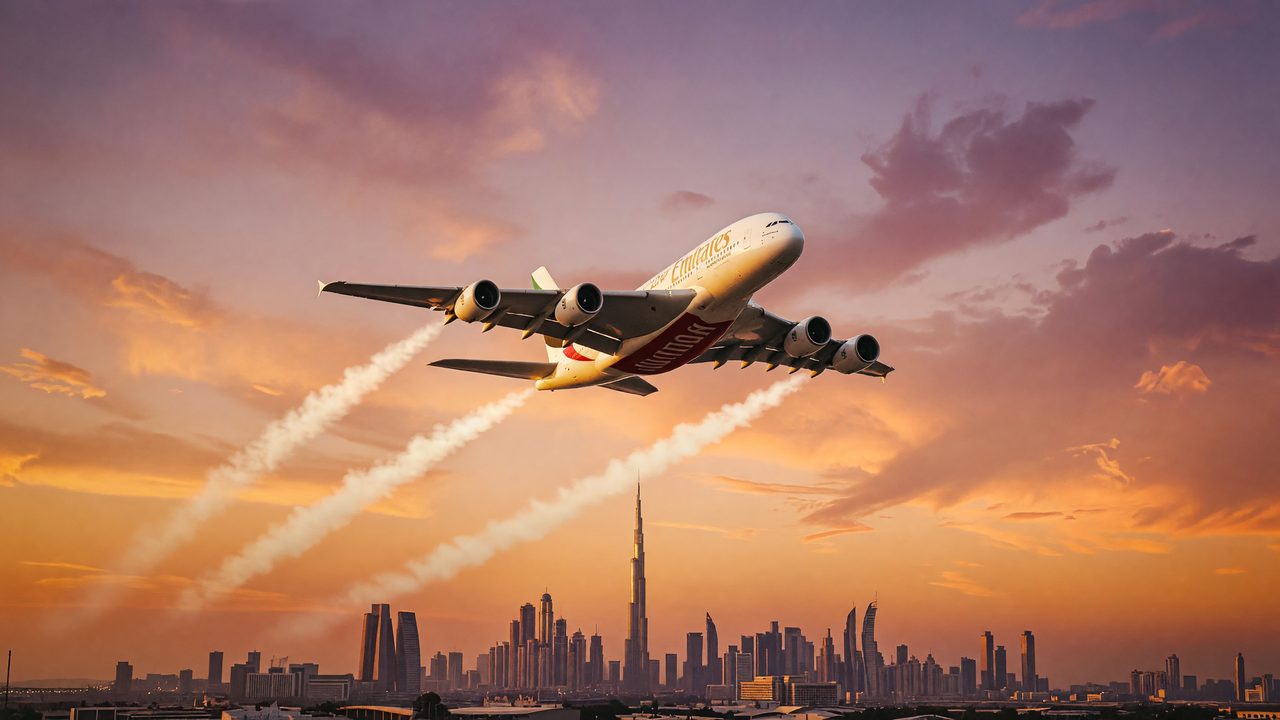
When Bigger Stopped Being Better: The Airbus A380
The only full-length double-deck airliner ever built carried more than 300 million people without a single fatal accident — and still could not outrun the economics of the sky.
On the morning of 27 April 2005, an enormous white shape lifted from Toulouse-Blagnac on four Rolls-Royce Trent 900 engines and turned the phrase “world’s largest commercial aircraft” from marketing copy into measured fact. Airbus’s own account of that first flight described an airframe engineered to move cities of people at once: a full-length double deck running nose to tail, a wing spanning nearly 262 feet, and a maximum takeoff weight north of 1.2 million pounds. Nothing like it had flown before. Nothing like it has flown since.
The A380 remains the only full-length double-deck jet ever built for airline service. European regulators codified its scale in EASA Type Certificate Data Sheet A.110: a certified maximum seating capacity of 853 passengers, with 868 approved for emergency evacuation demonstrations. Those numbers are not abstract. They are the hard ceiling on what a single departure can legally carry — a figure that dwarfs every other airliner in the sky. In everyday airline layouts, the airplane lived in more human proportions: roughly 525 seats in a three-class arrangement, or up to 615 in a dense two-class Emirates configuration that turned the upper deck into a long-haul living room for hundreds. Even at those “normal” densities, the A380 was less an aircraft than a vertical slice through a terminal concourse.
Passenger service began with Singapore Airlines, which took delivery of its first A380 on 15 October 2007 and inaugurated scheduled operations ten days later, on 25 October, on the Singapore–Sydney route. The jet’s early years belonged to the great hub carriers — Emirates above all, but also Singapore, Qantas, Lufthansa, British Airways, and others — carriers whose business models assumed passengers would converge on a few global crossroads before fanning out again. For that world, the superjumbo was not extravagance. It was arithmetic: fewer departures, more seats per slot, lower seat-mile cost on trunk routes where demand was thick and steady.
And the machine, judged as a machine, delivered. In two decades of airline service, the global A380 fleet flew more than 800,000 flights and carried over 300 million passengers without a single fatal accident — a safety record Airbus summarized in its December 2021 “A380 Facts and Figures” briefing, issued as production drew to a close. Pilots who flew it spoke of manners that belied the mass: stable in turbulence, surprisingly responsive for its weight class, a platform that made the extraordinary feel routine. Airport fire crews trained on its unique rescue geometry; engineers learned to service an aircraft whose sheer size demanded new ground equipment, wider taxiways, and gates that could swallow a building.
Yet perfection as an aircraft and relevance as a product are not the same thing. By the time Airbus built its 254th and final airframe in 2021, the industry’s center of gravity had shifted. Point-to-point long-range twins — lighter, cheaper to operate, easier to fill — eroded the hub-and-spoke volumes the A380 was built to absorb. Many airports never upgraded for Code F operations at all. A global shock to international travel in 2020–2021 accelerated retirements and parked superjumbos in deserts while airlines rethought frequency over capacity. The A380 did not fail because it was unsafe or unloved by passengers; it faded because the network economics that justified moving 500 people on one clock had thinned.
Why it matters to you
The A380 was engineered for 853 passengers and 800,000 flights without a fatal accident — a reminder that technical excellence and market survival are different exams. As you train for the cockpit, you inherit that lesson in every dispatch decision: the airplane’s certified capability is only half the equation. Payload, runway, gate, fuel price, load factor, and route structure determine whether today’s flight is viable. The superjumbo proved the sky could always be made bigger; it also proved that airports, schedules, and business models set the real limits. The best pilots do not merely fly the aircraft to its limits — they understand which limits the world still pays for.