Two Rivers, One Sky
"Invented twice. On opposite sides of a war."
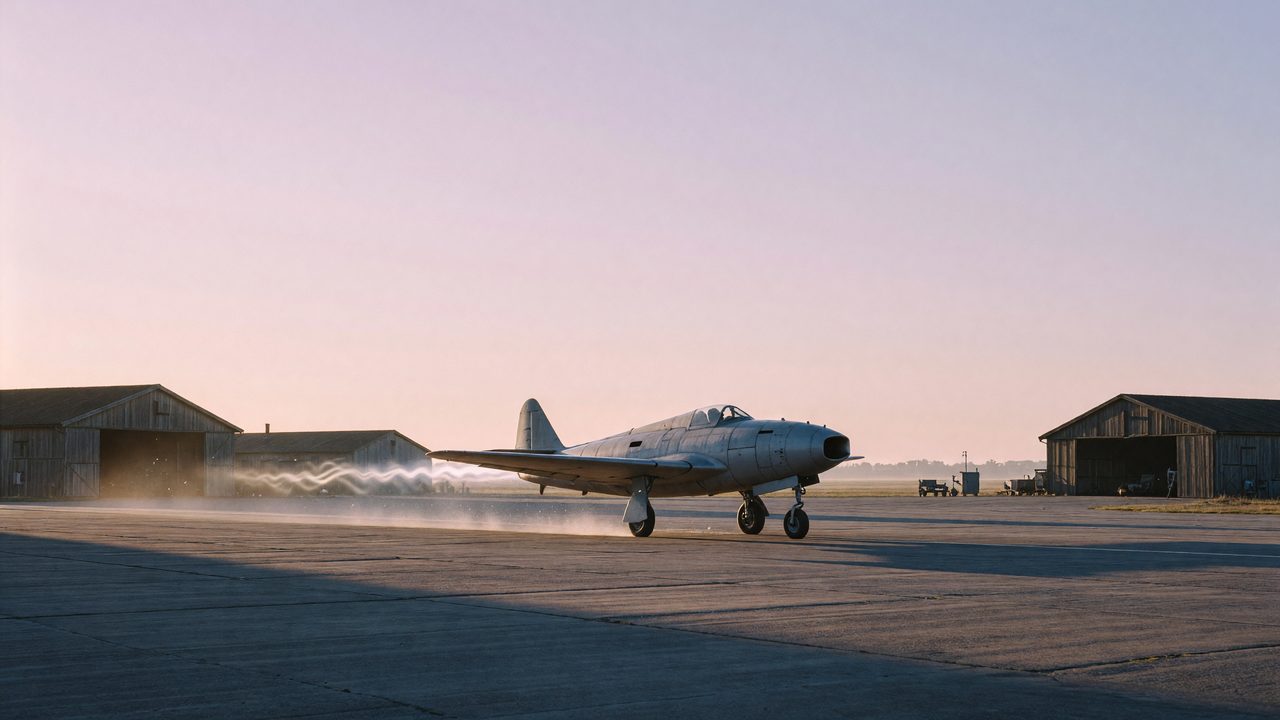
Two Rivers, One Sky
In the late 1930s, two engineers on opposite sides of Europe solved the same impossible problem — without knowing the other existed.
On a winter evening in 1928, a 21-year-old Royal Air Force cadet named Frank Whittle sat in his quarters at RAF Cranwell and drafted a thesis that read less like coursework and more like prophecy. He argued that a gas turbine — burning fuel in a continuous stream of compressed air — could propel an aircraft to speeds no piston engine could ever reach. Reciprocating engines, he understood, were approaching their physical ceiling. A turbine offered smooth, relentless thrust. Whittle patented the concept in 1930. The British Air Ministry reviewed it and found the idea interesting, perhaps, but impractical. Development funding proved elusive. In time, the patent lapsed into the public domain — a decision that would echo across the decade.
Five years later and a continent away, a young German physicist named Hans von Ohain sketched a strikingly similar concept in 1933. He was unaware of Whittle's work. Where Whittle had pitched bureaucrats, von Ohain walked into the office of Ernst Heinkel, an aircraft manufacturer with a reputation for bold experimentation. Heinkel recognized immediately what the Air Ministry had missed: if the turbine worked, it would rewrite the rules of speed and altitude. He funded von Ohain's research, and a small team began turning sketches into hardware.
The race that followed was not a race between two men — it was a race between two systems of belief. On August 27, 1939, just days before Germany invaded Poland and plunged Europe into war, von Ohain's Heinkel He 178 lifted from the grass at Marienehe and became the first aircraft in history to fly under jet power. The flight lasted minutes. The He 178 was fragile, underpowered, and never destined for mass production. But it proved the principle. Technical records preserved at the Deutsches Museum document an airframe barely larger than a conventional trainer, married to a centrifugal-flow engine that howled like nothing anyone on the ground had heard before.
Whittle's engine, the W.1, did not fly until May 15, 1941, when test pilot Gerry Sayer eased a Gloster E.28/39 into the air over Cranwell. By then, Germany had flown the world's first jet (the He 178, in 1939) but had not yet fielded an operational jet fighter like the Messerschmitt Me 262, which would not enter squadron service until 1944 — the world's first operational jet fighter. On paper, Whittle had been first to conceive and first to patent. In the air, he was second by nearly two years. The Rolls-Royce Heritage Trust's historical account makes clear that Whittle's design was, pound for pound, the more efficient engine. British bureaucracy — committee reviews, classification delays, and a war economy stretched thin — had cost him the lead he deserved. The patent that slipped into the public domain had not accelerated British development; it had simply removed one barrier while others multiplied.
After the war, the converging paths finally met. Von Ohain was brought to the United States under Operation Paperclip and assigned to Wright-Patterson Air Force Base in Ohio, where he continued refining jet propulsion for the U.S. Air Force. Whittle, knighted for his wartime contribution, lectured and consulted on both sides of the Atlantic. In 1966, the two men finally met face to face. According to accounts published in Air & Space Forces Magazine, they discovered not rivals but kindred spirits — engineers who had stared at the same physics and reached for the same answer. They became friends. They delivered joint lectures. Each acknowledged the other's place in history without bitterness, a grace rare among inventors who watch others claim the finish line.
Both men lived long enough to see their revolution complete. Turbojets gave way to turbofans. Airliners crossed oceans at eight-tenths the speed of sound. Fighters climbed faster than the speed of sound itself. Whittle died in 1996; von Ohain in 1998. Neither claimed sole credit. The Frank Whittle Legacy timeline records a man who understood that invention is rarely solitary — it is the product of ideas, timing, institutions, and sometimes plain luck.
Why it matters to you
The compressor at the heart of every jet engine you study in ground school traces directly to the design choices Whittle and von Ohain made in the 1930s. Whittle favored a centrifugal compressor — air thrown outward by a spinning impeller, then ducted forward into the combustion chamber. It was simpler, more robust, and easier to manufacture with wartime tooling. Von Ohain's early engines were also centrifugal, like the British design. Axial compressors—air passing straight through a series of spinning blade rows—came to dominate later production jets. Axial designs offered higher pressure ratios and better efficiency at altitude, but they demanded tighter tolerances and more sophisticated metallurgy. Rolls-Royce and General Electric adopted centrifugal designs for their earliest production turbojets — the same family of architecture that powered Whittle's W.1 — because reliability and rapid production mattered more than peak performance in 1944. As materials science matured and the demand for speed and fuel economy grew, the industry transitioned to axial-flow compressors, which dominate modern high-bypass turbofans today. When you study engine diagrams or work through turbine performance questions on a written exam, you are looking at the end state of a debate that began with two young men sketching impellers in notebooks. Understanding why early jets used centrifugal compressors — and why your training aircraft's turbofan almost certainly does not — is not trivia. It is the engineering logic behind every throttle advance you will ever make above FL250.