Twenty Years to the Ticket Counter: Galactic 01 Opens Virgin’s Commercial Era
"500 feet"
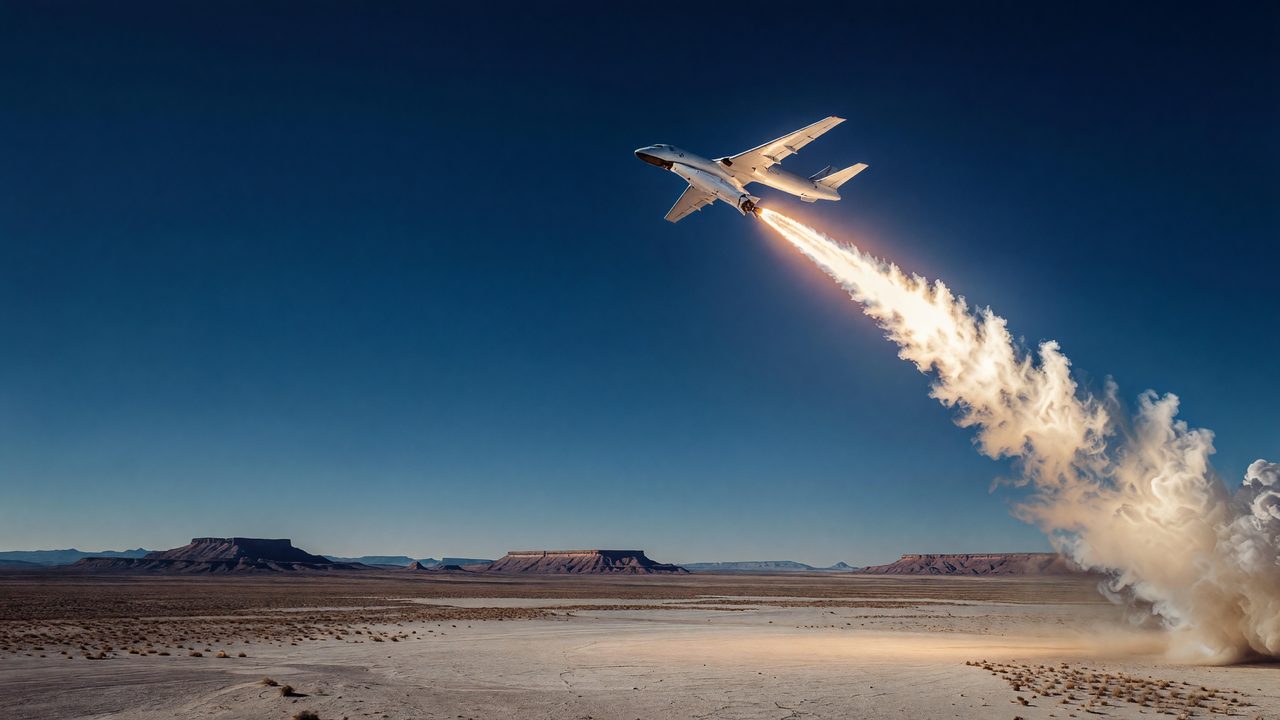
Twenty Years to the Ticket Counter: Galactic 01 Opens Virgin’s Commercial Era
On 29 June 2023, a rocket plane born from an X Prize prototype finally flew paying researchers—not test pilots—to the edge of space.
The Long Runway
When Richard Branson announced in 2004 that Virgin Galactic would ferry tourists to space, he imagined ticket sales opening by 2007. The calendar disagreed. Nearly twenty years passed between that promise and the morning Unity left Spaceport America’s concrete runway with a customer invoice in hand.
The delay was not idle. Virgin Galactic grew from SpaceShipOne, the tiny rocket plane that won the $10 million Ansari X Prize by reaching space twice in two weeks. Scaling Burt Rutan’s experimental craft into a repeatable commercial vehicle proved far harder than anyone forecast. Atmospheric tests of the SpaceShipTwo series began in 2010. Then, on 31 October 2014, the first prototype—VSS Enterprise—broke apart during a powered test ascent over the Mojave Desert, killing Scaled Composites co-pilot Michael Alsbury and injuring pilot Peter Siebold. The program nearly collapsed.
A replacement ship, VSS Unity, did not cross the 80-kilometre line until December 2018. Branson himself rode it in July 2021, a flight he called “extraordinary.” Commercial service still waited. Virgin halted operations for nearly two years to upgrade its carrier aircraft, VMS Eve, and the spaceplane fleet. A final qualification hop in May 2023 cleared the way for revenue flights. One fatal loss, one long grounding, and a test regimen measured in decades—not the marketing timeline Branson once sketched.
Galactic 01: Research Before Tourism
Mission Galactic 01 was not a joyride for wealthy adventurers. It was a purchased, dedicated research flight—the first of its kind in commercial suborbital spaceflight, as chief executive Michael Colglazier would emphasise after landing.
The twin-fuselage carrier Eve lifted from New Mexico at roughly 10:30 a.m. Eastern Daylight Time, climbing through desert air until it reached 44,500 feet. There, Unity dropped free. At 11:28 a.m. EDT its hybrid rocket motor ignited, burning for about a minute as the spaceplane punched out of the thick atmosphere on a ballistic arc.
At apogee, Unity stood 279,000 feet above the desert floor—52.9 miles, or roughly 85 kilometres. That altitude sits beyond the 50-mile threshold NASA and the Federal Aviation Administration recognise as the boundary of space, though it falls short of the 100-kilometre Kármán line favoured internationally. Through the cabin windows, the southwestern United States sprawled beneath the black curve of space.
In the pressurised cabin, three Italian researchers unstrapped for a few precious minutes of weightlessness. Colonel Walter Villadei and Lieutenant Colonel Angelo Landolfi of the Italian Air Force, with engineer Pantaleone Carlucci of the National Research Council, ran experiments on fluid mixing, combustion, and how composite materials behave without gravity. Villadei wore a prototype “smart flight suit” Virgin hoped might one day clothe ticket holders. Company astronaut instructor Colin Bennett floated with them. Up front, pilots Mike Masucci and Nicola Pecile—on their fourth and first spaceflights respectively—managed the powered climb and the feathered re-entry that followed.
The rocket-powered segment lasted about fourteen minutes from motor ignition to runway touchdown. The entire mission ran roughly seventy-two minutes. Blue Origin had already flown paying passengers on its ground-launched New Shepard capsule; Dennis Tito had bought an orbital ride aboard a Soyuz in 2001. Galactic 01 was different: a contracted science mission aboard a winged rocket plane, proving that the tourism architecture could earn revenue beyond spectacle.
What Comes Next
Virgin Galactic had roughly eight hundred ticket holders waiting, some for more than a decade, at prices that climbed toward $450,000 per seat. Unity carries only a handful of passengers per flight, and in mid-2023 the company planned roughly one mission per month—enough to clear the backlog slowly. A faster cadence depends on a future “Delta class” fleet Virgin aimed to introduce around 2026, with weekly flights.
Galactic 02, carrying the first private ticket holders, was scheduled for August 2023. The Italian government paid for Galactic 01, though neither party disclosed the fee. For Branson, the flight answered a question that had shadowed his brand since SpaceShipOne’s triumph: could suborbital spaceflight become a business, not merely a stunt?
Why it matters to you
The engineering lineage from Galactic 01 reaches the cockpit you occupy today. Air-launch concepts—carrying one aircraft aloft to release another—echo in military test programmes and civilian launch experiments. The “feather” tailboom reconfiguration that stabilised Unity during unpowered descent is a lesson in variable geometry and energy management, ideas that surface whenever you study how an airframe trades lift, drag, and structural load across flight regimes. The 2014 accident and the subsequent two-year stand-down mirror the flight-test culture every certificated pilot inherits: envelope expansion only after data, redesign after failure, and no shortcut past demonstrated safety. When you brief a go/no-go decision, manage energy on approach, or read an airworthiness directive born from someone else’s mishap, you are practising the same discipline that kept Unity alive long enough to carry Italian researchers above the Kármán debate and back to a runway in the New Mexico sun. Commercial space did not leave aviation behind. It climbed out of it—and then glided home.