Twelve Thousand Cycles to Failure
"A single plate became two. Twelve thousand pressurization cycles later, 520 souls paid for the shortcut."
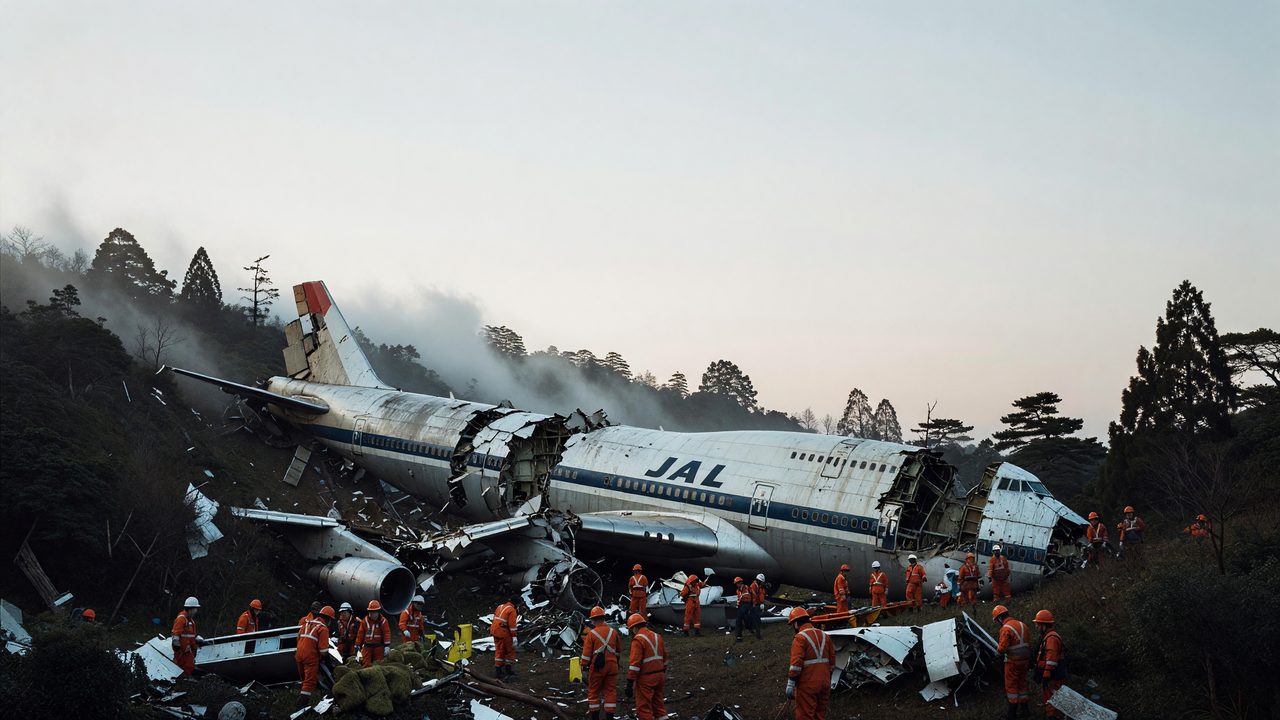
Twelve Thousand Cycles to Failure
On 12 August 1985, a Boeing 747 that had flown safely for seven years after a tail-strike repair broke apart in the sky—not because the crew failed, but because a splice no one re-inspected had been waiting to fail since 1978.
The flight that should have been routine
Japan Airlines Flight 123 lifted from Tokyo-Haneda at 18:12 local time bound for Osaka with 509 passengers and 15 crew aboard JA8119, a high-cycle Boeing 747-SR100 built for domestic Japanese routes. Twelve minutes later, at roughly 24,000 feet over Sagami Bay, the aft pressure bulkhead failed catastrophically. The explosive decompression tore through the rear fuselage, blew off the vertical stabilizer and auxiliary power unit, and severed all four hydraulic systems. What remained was a 747 without meaningful flight controls—yet Captain Masami Takahama and his crew would keep the crippled jet in the air for another 32 minutes.
The Aircraft Accident Investigation Commission of Japan’s Ministry of Transport, in its report of 19 June 1987, traced the rupture to a repair performed after a tail-strike landing at Osaka-Itami on 2 June 1978. During that incident, the aircraft’s aft fuselage scraped the runway; the damage centered on the aft pressure bulkhead, the dome-shaped structure that seals the rear of the pressurized cabin. Boeing’s repair manual called for a single, continuous doubler plate—essentially one uninterrupted patch spanning the damaged section. The work actually done used two overlapping splice plates, joined along a rivet line that cut across the bulkhead’s curved geometry.
Stress where the manual said there should be none
An aft pressure bulkhead does not merely hold air inside the cabin. On every climb and descent it flexes under cyclic pressurization loads—loads repeated thousands of times across a 747’s career. Boeing’s single-plate design distributes those stresses across a continuous surface. The dual-plate repair concentrated them at the splice joint, where rivet holes became initiation sites for fatigue cracks.
The commission found that cracks had been propagating from that joint across 12,319 pressurization cycles—roughly seven years of operation—without anyone detecting them. The bulkhead had not been opened for inspection after the repair. The splice plates themselves were not the wrong material; the deviation was structural and procedural. A repair that looked adequate on a paperwork close-out had, in effect, embedded a countdown timer into the airframe.
When the bulkhead finally gave way on Flight 123, the pressure release was not a slow leak. Investigators described an explosive event that destroyed primary structure aft of the cabin and left the crew with only engine thrust and trim to fight a phugoid—an unstable pitch oscillation that grew worse as hydraulic fluid bled away.
Thirty-two minutes over the mountains
First Officer Yutaka Sasaki and Flight Engineer Hiroshi Fukuda worked beside Captain Takahama as the aircraft wandered over mountainous terrain northwest of Tokyo. The crew transmitted distress calls; controllers heard them. Passengers wrote final messages. The 747 descended in a series of porpoising maneuvers, at times nearly recovering enough stability to suggest a miracle might be possible.
It was not. At approximately 18:56, the aircraft struck a ridge on Mount Osutaka in Gunma Prefecture at an elevation near 5,000 feet, cartwheeling into the forest. Of 524 people on board, four survived—all seated in the mid-fuselage aft of the wings, where deceleration forces were marginally less severe. Five hundred and twenty perished. No other single-aircraft accident in aviation history has claimed more lives.
The NTSB, in safety recommendation letters A85-133 through A85-137 issued in 1985, urged broader attention to pressure-vessel integrity and repair documentation—lessons the American regulator drew from an accident in Japanese territory because the failure mode belonged to the global 747 fleet. Rescue operations, hampered by darkness, rugged terrain, and delayed helicopter access, became their own grim chapter; many who might have survived the impact did not survive the night.
The repair that was never revisited
The 1978 tail-strike had been investigated and documented. The repair was signed off. What did not happen afterward is the hinge of the tragedy: no program required dismantling the bulkhead splice for periodic inspection, and no subsequent heavy check treated that joint as a life-limited structural suspect. Fatigue, patient and invisible, did the rest.
The FAA’s Lessons Learned entry for JA8119 compresses the moral into a single maintenance principle: structural repairs are not finished when the paperwork is filed—they are finished when the airframe proves, through inspection and conformity, that the repair matches the manufacturer’s intent.
Why it matters to you
Every preflight walkaround and every systems quiz you complete rests on an assumption that someone, somewhere, repaired the aircraft exactly as the manual prescribed—and then proved it. JAL 123 shows how a seemingly minor deviation, two overlapping plates instead of one continuous doubler, can convert a certified repair into a stress concentrator that survives 12,319 cycles before failing without warning. As a pilot you will never sign off a bulkhead splice, but you fly inside the consequences of those who do. When you study abnormal pressurization, hydraulic loss, or the limits of controllability, you are studying the last 32 minutes of Flight 123. The sharper skill is earlier: treating maintenance conformity not as background paperwork but as part of the aircraft’s aerodynamics. A rivet line out of place is not a detail. On a pressure vessel, it is a flight control.