Twelve Seconds That Rewrote the Sky
"12 seconds that changed everything"
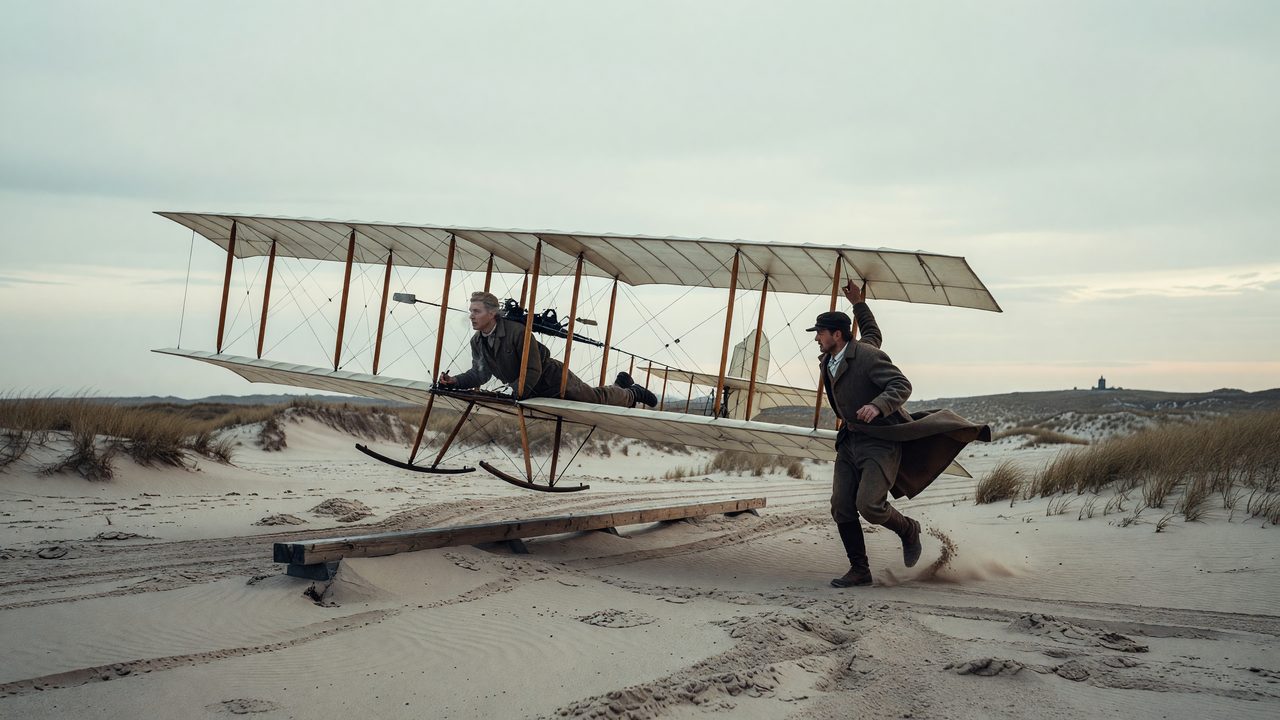
Twelve Seconds That Rewrote the Sky
On a windy December morning at Kitty Hawk, two bicycle mechanics proved that controlled flight was not a dream—but a skill you could learn.
The Machine on the Rail
By the winter of 1903, Wilbur and Orville Wright had already spent four years turning the Outer Banks of North Carolina into their private flight laboratory. From the dunes of Kill Devil Hill they had launched more than a thousand glider flights, teaching themselves to read the air in ways no one else had. According to the National Park Service’s account at Wright Brothers National Memorial, they understood what their well-funded rivals did not: you could not solve flight from the ground. A human being had to fly the machine.
That December, their camp held a 40-foot biplane of spruce and ash, skinned in finely woven cotton sealed against the salt air. The Wright Brothers Aeroplane Company records the empty weight at 605 pounds—without the pilot stretched prone on the lower wing. A homemade four-cylinder engine drove twin pusher propellers through bicycle chains, one crossed so the blades spun in opposite directions and canceled the torque that had plagued earlier experimenters. Launch came from a 60-foot wooden rail, not a runway. There was no cockpit, no windshield, no throttle quadrant—only levers, a hip cradle, and the accumulated judgment of men who had already crashed once that week.
December 14 and the Coin Toss
Three days before history, Wilbur won a coin toss and drew the first attempt. He left the rail on December 14, but pulled too aggressively on the forward elevator and stalled into the sand, damaging the aircraft. Repairs cost precious time. When the brothers returned on the morning of December 17, a 27-mile-per-hour headwind scoured the dunes—stiffer than they preferred, since their Flyer cruised near 30 to 35 miles per hour. Against that wind, groundspeed would crawl. They signaled volunteers from the nearby Kitty Hawk Lifesaving Station with a bedsheet and pressed on. Orville took the controls.
10:35 A.M.
At 10:35, Orville released the restraining wire. The Flyer trundled down the rail while Wilbur ran alongside, steadying the right wing until the machine lifted free. John T. Daniels, one of the lifesavers, tripped the shutter on a preset camera—the photograph that would eventually circle the globe.
The flight was anything but graceful. The Wrights’ own journals describe an unruly craft, pitching up and down as Orville worked the controls. He shifted his hips in a cradle to warp the wings and swing the twin vertical rudders; a stick forward of his left hand moved the elevator mounted ahead of the wings. Into the gale, the machine covered about 120 feet in roughly 12 seconds before settling onto the sand. Groundspeed was barely seven miles per hour; airspeed, about 34. The distance was shorter than the wingspan of a modern narrow-body jet—but it met the standard the brothers had set for themselves: powered, piloted, controlled, and sustained.
Four Flights, Then Silence
They were not finished. Taking turns, the brothers flew three more times that day, each outing longer as their hands learned the machine’s moods. Wilbur’s final pass, the fourth flight of the day, stretched 852 feet and lasted 59 seconds—nearly a minute aloft over the dunes. The Wright Brothers Aeroplane Company notes that the brothers regarded this last hop as the only fully successful flight of the morning.
Then the wind intervened. While the Flyer rested near the camp, a gust caught it, rolled it over, and smashed it beyond quick repair. The 1903 machine never flew again. The brothers wired their father a telegram with spare numbers and caught the train home to Dayton. The era of practical aviation had opened in less than two hours—and almost no one noticed.
What “First” Actually Meant
Others had left the ground under power before. What separated the Wrights was control across three axes—roll, pitch, and yaw—on a machine that could be flown repeatedly by the same pilots who built it. Their wing-warping has long since given way to ailerons, but the logic endures. Every time you ease back on the yoke, coordinate rudder in a steep turn, or catch a wing before it drops in a gust, you are exercising the same fundamental idea Wilbur and Orville proved in those twelve seconds: an aircraft is only as useful as a pilot’s ability to command it.
Why it matters to you
When you practice slow-flight recoveries or deliberate stall entries during training, you are not checking boxes on a syllabus—you are rehearsing the same problem Orville fought at 10:35 on December 17, 1903. The Wrights’ three-axis system—wing-warping for roll, a forward elevator for pitch, twin rudders for yaw—is the direct ancestor of every control surface you move today. Modern aircraft separate roll control onto ailerons and bury the elevator in the empennage, but the pilot’s job is unchanged: sense an attitude excursion, apply the right input in the right axis, and recover before the sand—or the runway margin—runs out. The Flyer’s first flight was shorter than an airliner’s wingspan. Your next lesson in coordinated flight is part of its legacy.