Thirty Seconds of Fuel and a Lifetime of Training
"650 million people watched one man step off a ladder."
Thirty Seconds of Fuel and a Lifetime of Training
On July 20, 1969, a former naval aviator turned test pilot landed a fragile spacecraft on another world with less than half a minute of propellant left—and changed what pilots believe is possible under pressure.
The Descent That Almost Ran Dry
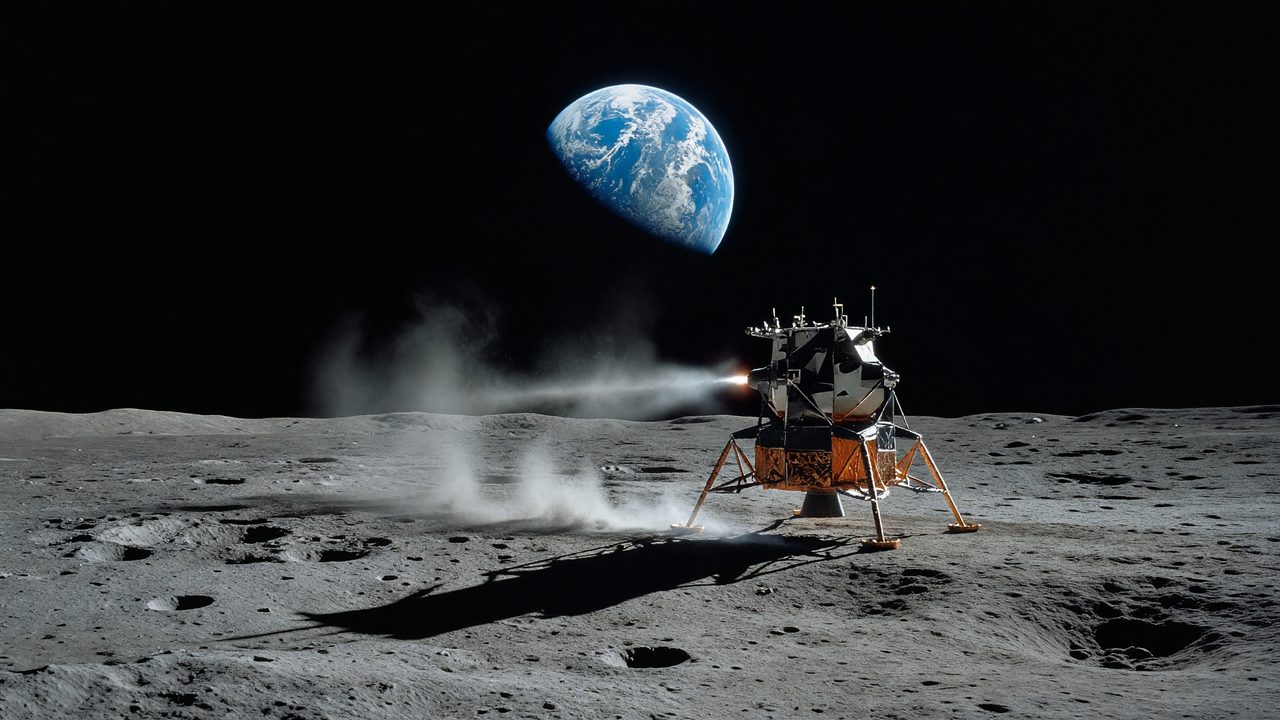
When Neil Armstrong and Buzz Aldrin separated from Michael Collins in the command module Columbia and descended in the Lunar Module Eagle, they were executing one of the most demanding piloting tasks ever attempted. The target was the Sea of Tranquility, a broad basalt plain near the lunar equator. What NASA’s Apollo 11 Mission Overview and the post-flight Apollo 11 Mission Report (MSC-00171, November 1969) document in dry technical language is a cockpit drama: the powered descent was not a gentle glide but a controlled burn against gravity, terrain, and a rapidly shrinking fuel budget.
Armstrong’s background mattered. He had flown fighters from aircraft carriers, pushed the X-15 beyond the edge of the atmosphere, and—fourteen months before the landing—in May 1968 ejected from a failing Lunar Landing Research Vehicle at NASA’s Ellington Field. That uncrewed trainer mimicked lunar descent dynamics; its crash would have killed most pilots. Armstrong walked away. By the time Eagle reached the Moon, his reputation for composure under mechanical failure was already established among the astronaut corps.
A Pilot’s Eyes on an Alien Runway
Automated guidance was supposed to place Eagle in a safe landing zone. Instead, Armstrong confronted a field strewn with boulders and craters—terrain no simulator had fully prepared him for. He took manual control, flying the LM like an experimental aircraft while Aldrin called altitude, velocity, and fuel remaining. The Mission Report’s trajectory data and crew debriefings, summarized in museum and agency histories including the National Air and Space Museum’s account of the landing, confirm the outcome: Armstrong touched down with propellant reserves equivalent to roughly thirty seconds of hover time remaining. In aviation terms, he had reached minimums with no go-around option.
“Houston, Tranquility Base here,” Armstrong radioed. “The Eagle has landed.” Nineteen minutes later, Aldrin joined him on the surface. For two and a half hours they worked in bulky pressure suits, deploying experiments, planting the flag, and speaking to a planet watching in real time.
Alone on the Far Side
While the lunar module crew worked below, Collins remained in lunar orbit aboard Columbia, completing each 2.3-hour circuit alone. During every pass behind the Moon, he lost contact with Earth and with his crewmates—brief intervals in which historians and NASA chroniclers have described him as the most isolated human being in history. Rendezvous logic demanded precision: if Eagle could not lift off, Collins would return home alone. He later called his role not lonely but a “happy” responsibility, yet the orbital mechanics left no margin for sentiment. The mission’s success depended on clockwork timing across three separate flight paths.
Samples, Silence, and Home
Armstrong and Aldrin spent about 21.5 hours on the lunar surface—one sleep period, one EVA, and a launch that had to mate with Columbia in orbit. They collected approximately 47.5 pounds of lunar samples, rock and soil that would anchor decades of planetary science. On July 24, 1969, the command module splashed down in the Pacific. An estimated 650 million people—roughly one in five humans alive—had watched the landing live, a broadcast achievement without precedent.
The architecture that made the mission possible was lunar orbit rendezvous: send a lightweight lander and a command module to the Moon, land one, then dock in orbit for the ride home. NASA engineer John Houbolt championed the concept against early opposition from leaders who favored direct ascent or Earth orbit rendezvous. His persistence shaped Apollo’s flight plan and, according to agency mission summaries, the propellant math that allowed Eagle to reach the surface at all.
Why it matters to you
Modern pilots training for precision flying—whether in simulators or in aircraft with flight management systems—inherit a lesson Apollo 11 engraved in flight history: automation proposes, but the human must be ready to assume control when the prepared surface is not the surface that appears. Armstrong’s LLRV ejection and his last-minute lunar landing were not separate stories; they were the same habit of mind, practiced until crisis looked like procedure. The lunar orbit rendezvous profile Houbolt fought to validate also foreshadowed how crews today approach orbital rendezvous and docking—establishing co-elliptic phases, monitoring closure rates, and executing a tight join-up window where fuel, attitude, and timing cannot be bought back. When you brief a hold, a missed approach, or a hand-flown final segment, you are training the same discipline that kept Eagle from becoming a footnote: know your abort boundaries, fly the machine you have, not the one you expected, and treat every second of reserve fuel as the only one you will get.