Thirty-Eight Minutes Over Lockerbie
"A Toshiba radio, a Semtex charge, and a town that never expected to fall from the sky."
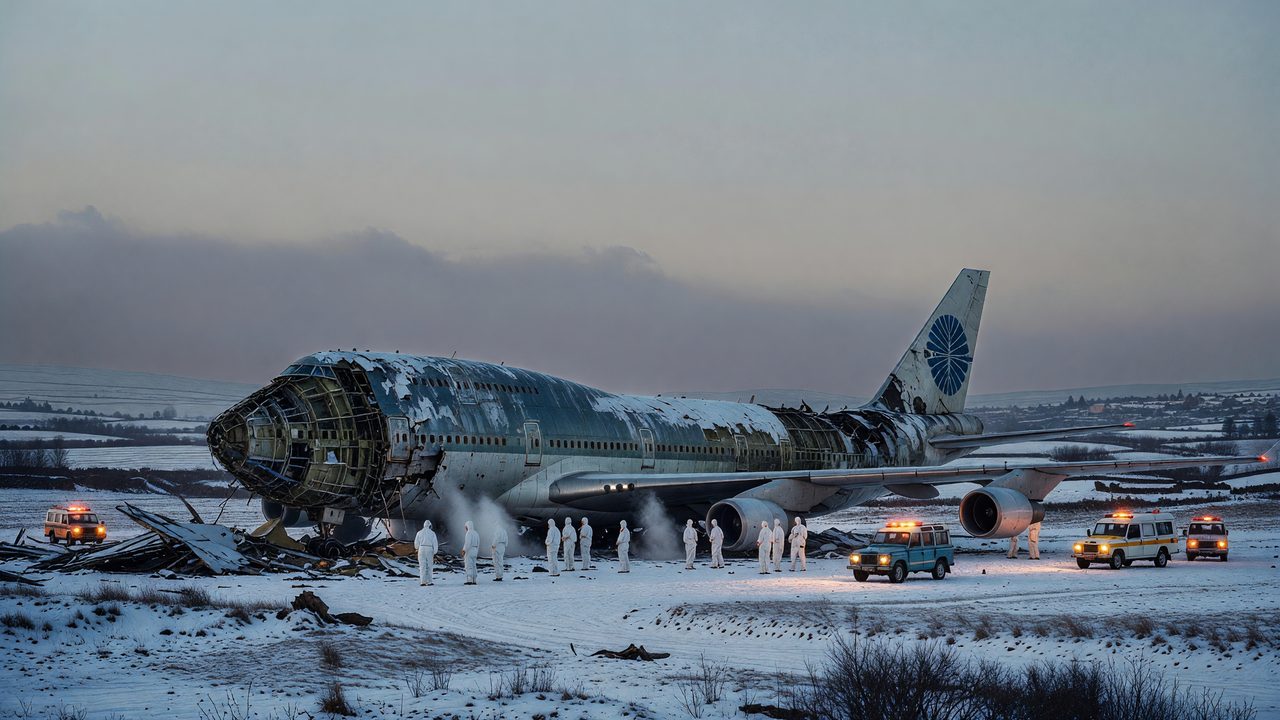
Thirty-Eight Minutes Over Lockerbie
On a winter evening in 1988, a Boeing 747 climbing out of London carried a bomb nobody aboard knew was there—and the catastrophe that followed forced governments worldwide to rebuild how they screen what goes into the hold.
The Last Ordinary Departure
Pan American World Airways Flight 103 left London Heathrow on December 21, 1988, bound for New York Kennedy. The aircraft was a Boeing 747-121, registration N739PA, christened Clipper Maid of the Seas. Among the 259 people aboard were students returning home for Christmas, diplomats, intelligence officers, and families crossing the Atlantic for the holidays. The flight was routine in every visible respect: cleared, fueled, boarded, and airborne into a darkening Scottish sky.
Thirty-eight minutes after takeoff, at approximately 31,000 feet above the market town of Lockerbie, Dumfriesshire, an improvised explosive device detonated in the forward cargo hold. The U.K. Air Accidents Investigation Branch, in its formal report on the accident to N739PA, concluded that the blast initiated structural breakup at altitude. The 747 disintegrated. Wreckage and bodies fell across 845 square miles of countryside, according to the FBI’s case history—an area so vast that investigators would eventually recover 319 tons of debris. On the ground in Lockerbie, falling sections of fuselage and engines killed eleven residents. Two hundred seventy people died in all—the deadliest terrorist attack against American civilians until September 11, 2001.
What the Wreckage Said
The AAIB investigation treated Lockerbie as both an air accident and a crime scene. Forensic teams combed fields, rooftops, and forest floors through a Scottish winter. In the debris, investigators recovered fragments of a Toshiba Bombeat radio-cassette player and traces of a timing device. The FBI’s account of the case describes how microscopic evidence—a timer fragment embedded in a piece of shirt, other shards linked to the radio—helped establish that the bomb had been concealed inside checked luggage, not carried into the cabin.
The criminal inquiry, pursued jointly by Scottish authorities and the FBI, reconstructed the bag’s path. Investigators concluded that the explosive had been hidden inside a Samsonite suitcase and loaded as unaccompanied interline baggage: transferred from an Air Malta flight into the international baggage system at Frankfurt, then onward to Heathrow and into the hold of Pan Am 103. The passenger who was supposed to own that bag was not on the aircraft. In 1988, that gap in the system was not merely theoretical. It was exploitable.
A Security Regime Built for Another Era
The President’s Commission on Aviation Security and Terrorism, reporting to Congress in May 1990, found that the bombing might well have been prevented. Its findings were blunt. The aviation security system of the late 1980s had not kept pace with a world in which bombings had become terrorists’ preferred method of attack against civil aviation. Intelligence was gathered but not always acted upon. Oversight of airline and airport security was thin. Research into explosives detection lagged behind the threat.
At Frankfurt and Heathrow, the commission concluded, gaping holes ran through the system—and through one of those holes slipped the device that killed 270 people. Baggage screening was inconsistent. Mandatory confirmation that every checked bag belonged to a passenger actually aboard the flight was not the universal standard pilots and travelers might assume today. Hold baggage on international services could move through transfer points with screening that varied by airport, airline, and country.
The commission issued sixty-four recommendations, from elevating security leadership within the federal government to deploying federal security managers at high-risk airports, tightening screener standards, and accelerating explosives-detection research. Many were enacted through the Aviation Security Improvement Act of 1990.
Justice, Responsibility, and Reform
The investigation stretched across years and continents. In 1991, British and American authorities charged two Libyan intelligence operatives. Abdelbaset al-Megrahi stood trial in 2000 before a Scottish court convened in the Netherlands; he was convicted in 2001 and sentenced to life imprisonment. Libya later accepted responsibility for the attack and paid $2.7 billion in compensation to victims’ families.
While courts addressed accountability, regulators addressed vulnerability. The FAA, in a 1998 fact sheet cataloguing security initiatives after Pan Am 103, noted that within days of the bombing it had required U.S. carriers operating from Western Europe and the Middle East to X-ray or physically search checked bags, conduct additional random inspections, and achieve positive passenger-baggage matching to keep unaccompanied luggage off aircraft. Subsequent rulemaking mandated explosives detection systems for international checked baggage, incorporated ICAO passenger-baggage matching standards, and expanded federal security presence at major airports overseas. Pan Am itself faced proposed civil penalties for alleged security violations at Heathrow and Frankfurt discovered during FAA inspections after the crash.
None of that restored the lives lost on Sherwood Crescent and in the skies above Lockerbie. But it changed the operating assumptions of every pilot who now files a flight plan across the North Atlantic.
Why it matters to you
When you brief an international departure today, the passenger-baggage match and hold-screening requirements that can delay pushback or trigger bag searches are not abstract bureaucracy. They are direct responses to how Pan Am 103 was destroyed. The bomb rode in unaccompanied luggage that entered the system through an Air Malta transfer at Frankfurt because, in 1988, there was no mandatory, end-to-end requirement that every piece of checked baggage be positively linked to a traveler on board that specific flight. A terrorist did not need to board the 747; they only needed to exploit the seams between airlines and airports. Lockerbie closed those seams—or tried to: ICAO standards, FAA mandates for X-ray and explosives-detection screening of international hold baggage, and positive bag-match procedures all trace their modern urgency to that December evening. As a pilot, you will rarely see the security layer that protects your aircraft, but you depend on it every time cargo and suitcases are loaded beneath the cabin floor. Understanding why that layer exists is part of understanding the aircraft you are responsible for—not just its systems, but the history written into the rules that govern what may be placed inside it.