The White Rocket That Rewrote the Rules
"On the afternoon of 4 June 2010, a slender white rocket r..."
The White Rocket That Rewrote the Rules
On a Florida afternoon in June 2010, a privately built two-stage launcher proved that entrepreneurial discipline could reach orbit—and changed how pilots think about risk, iteration, and the cost of getting somewhere.
A Company Built on a Bet
When Elon Musk incorporated Space Exploration Technologies—SpaceX—in 2002, he did not inherit a government launch complex or a standing army of aerospace contractors. He started with a small team of engineers and a single, audacious premise: that reaching Earth orbit could be made dramatically cheaper if a company designed, built, and flew its own rockets under commercial discipline rather than cost-plus bureaucracy. The Falcon 9 was the vehicle meant to prove that premise at scale—a two-stage, liquid-fuelled launcher sized to carry cargo, and eventually people, beyond the atmosphere.
Development was financed through private capital and milestone payments under NASA’s Commercial Orbital Transportation Services programme. SpaceX was not waiting for a traditional procurement award; it was earning its way forward flight by flight, with each success—or failure—feeding directly back into the next design iteration.
Drama at the Cape
The afternoon of 4 June 2010 brought that bet to Cape Canaveral’s Space Launch Complex 40. Controllers opened a lengthy launch window, but the day was anything but routine. Telemetry connectivity problems between the rocket and an Air Force range facility pushed the attempt deep into the window. Then, on the first try, a pressure anomaly in one of the first stage’s nine Merlin engines triggered an automatic abort seconds before ignition.
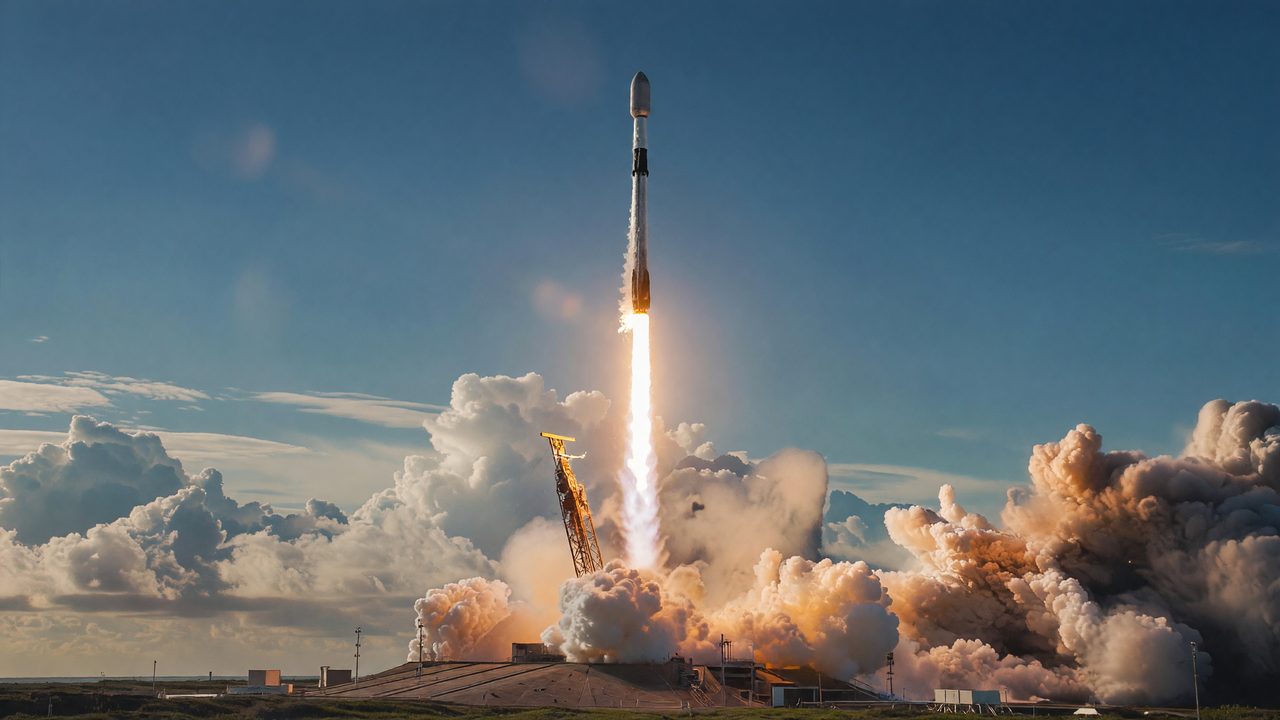
For any flight operation—whether in a Cessna or atop a fifteen-story booster—the lesson is the same: abort, diagnose, and only then commit. SpaceX engineers cleared the glitch as non-critical. Seventy-five minutes later, hydraulic hold-down clamps released, a million pounds of kerosene-fuelled thrust tore through thin cloud, and the slender white Falcon 9 climbed on a golden exhaust plume above the Space Coast.
Two Stages, One Bullseye
The first stage carried the vehicle past roughly fifty miles before shutting down and separating. The upper stage, with its vacuum-optimised Merlin engine, then ignited for a burn of several minutes. Onboard video showed more roll than expected—a deviation engineers would study before the next flight—but the stage still delivered. Telemetry placed the Dragon Spacecraft Qualification Unit into a near-perfect orbit roughly 250 kilometres high, inclined 34.5 degrees to the equator. SpaceX reported perigee and apogee within about one percent of target.
It was the first time a privately developed rocket of that class had achieved Earth orbit from American soil. The payload was not a operational cargo capsule on this flight; it was a qualification unit, remaining attached to the upper stage as planned. But the trajectory was real, the margins were real, and the message was unmistakable: a startup could do what had long been treated as the exclusive province of national programmes.
Opening the Commercial Era
That single ascent unlocked what followed. Subsequent Falcon 9 missions would carry the Dragon spacecraft through demonstration flights, and Dragon would go on to berth with the International Space Station—ushering in a commercial resupply era that shifted station logistics toward fixed-price contracts and reusable hardware. The Falcon 9 family has since flown hundreds of missions, but the physics of the first flight did not change: nine engines on the pad, two stages to orbit, and a company willing to scrub, recycle, and launch again within the same window.
Contemporary reporting from Spaceflight Now, SpaceNews, and MIT Technology Review captured both the political debate of the moment and the engineering reality on the pad. NASA Administrator Charles Bolden noted that the flight strengthened confidence in commercial cargo delivery after the space shuttle’s retirement. Musk, for his part, framed the day as vindication of a commercial path to orbit—not a replacement for exploration, but a new way to reach the threshold where exploration begins.
Why it matters to you
The judgment and discipline demonstrated on that June afternoon—the aborted first attempt, the calm recycle, the refusal to accept “good enough” when the orbit solution demanded precision—are the same qualities that define airmanship today. Student pilots learn to brief honestly, to honour abort criteria before ego enters the cockpit, and to treat every anomaly as data rather than defeat. Rated pilots live that standard on every instrument approach and every crosswind landing. SpaceX’s Falcon 9 did not fly because someone willed a rocket into the sky; it flew because a team applied procedural rigour under pressure, accepted a scrub when the numbers said scrub, and returned to execute when conditions allowed. Whether your destination is a 3,000-foot grass strip or a 250-kilometre orbit, the contract is identical: know your limits, trust your instruments, and only go when the mission—not the schedule—gives the green light.