The Hold Had No Eyes: ValuJet 592 and the Fire Nobody Saw Coming
"Oxygen generators without safety caps. A cargo hold without fire detection. One hundred and ten people had no warning."
The Hold Had No Eyes: ValuJet 592 and the Fire Nobody Saw Coming
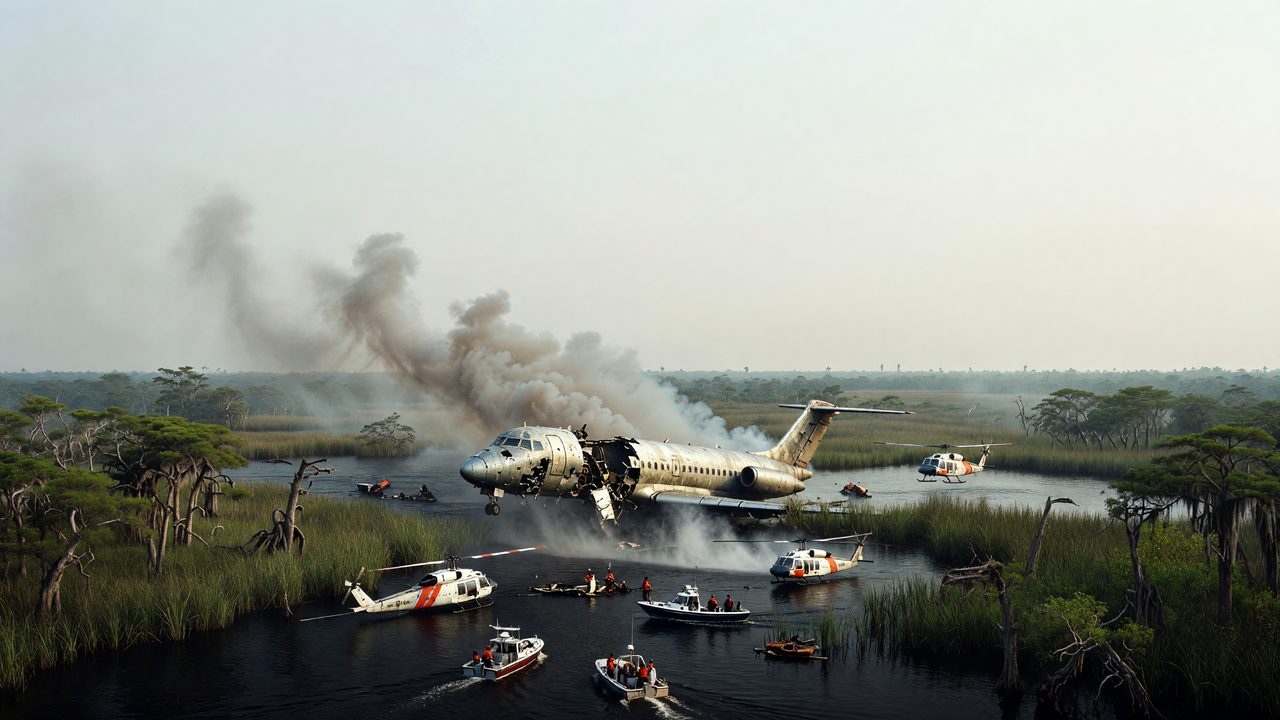
On May 11, 1996, a DC-9 dove into the Florida Everglades ten minutes after leaving Miami—not because of engine failure or weather, but because a forward cargo bay designed to starve fires of oxygen instead concealed one that manufactured its own.
A Routine Departure, an Invisible Threat
ValuJet Flight 592, a McDonnell Douglas DC-9-32 registered N904VJ, lifted off from Miami International Airport under visual conditions on an instrument flight plan bound for Atlanta. Aboard were two pilots, three flight attendants, and 105 passengers. The flight appeared ordinary. What the cockpit crew could not know was that the forward cargo compartment—a Class D bay under 14 CFR Part 25—already held the ingredients of catastrophe.
Shortly before departure, five cardboard boxes and three wheel-and-tire assemblies had been loaded as company material, or COMAT. The boxes contained approximately 144 chemical oxygen generators removed from two ValuJet MD-82 aircraft, N802VV and N803VV, undergoing renovation at SabreTech’s Miami maintenance facility. Most retained unexpended oxidizer cores. Their twelve-year service lives had expired. According to the NTSB’s preliminary findings, shipping caps that prevent accidental activation of the percussion-fired mechanisms were not installed. A SabreTech shipping document dated May 10, 1996, identified the generators as “Oxy Cannisters” but marked them “Empty”—a characterization the investigation would treat as gravely misleading.
Oxygen Generators Are Not Inert Cargo
Manufactured by Scott Aviation, each generator is a compact cylinder—roughly the size of a spray-paint can—containing a solid oxidizer core composed chiefly of sodium chlorate, with barium peroxide, potassium perchlorate, and trace materials. When the firing pin is released, an exothermic decomposition reaction produces oxygen for at least fifteen minutes. Manufacturer testing cited in NTSB Safety Recommendations A-96-025 through A-96-028 recorded external shell temperatures reaching roughly 500 degrees Fahrenheit.
When installed in approved overhead passenger-service units, generators are engineered to operate safely. Removed from that context and tossed into cardboard boxes, they are another matter entirely. Under Department of Transportation hazardous-materials regulations in 49 CFR Parts 171–180, chemical oxygen generators transported as cargo are classified as oxidizers, subject to packaging, labeling, and shipping requirements. ValuJet’s COMAT chain treated them as internal airline freight instead—no hazmat declaration, no approved containment, no safety caps.
The Class D Compartment’s Fatal Assumption
Federal certification rules divide lower fuselage cargo bays into types. Class C compartments must carry approved smoke detection and built-in fire suppression controllable from the flight deck. Class D compartments carry neither. They are certified on the assumption that limited oxygen and controlled leakage will suppress combustion before it endangers the airplane.
That logic collapses when cargo itself becomes an oxygen source. The NTSB’s fire tests for Aircraft Accident Report AAR-97/06 demonstrated how an activated generator could heat adjacent material in an oxygen-enriched environment, rupture an inflated main-gear tire, and propagate flame through the forward hold. Because the DC-9’s Class D bay had no detection or suppression equipment—and none was required—the flight crew received no warning from the compartment where the fire almost certainly began.
The first hint arrived through human senses, not instruments. At 14:10:03, the cockpit voice recorder captured an unidentified sound; the captain asked, “What was that?” Flight data recorder anomalies consistent with a ruptured tire followed within seconds. By 14:10:25, voices in the passenger cabin were shouting “fire, fire, fire.” Smoke and flame were entering the cabin and cockpit. Less than four minutes later, at 14:13:42, the aircraft struck the Everglades. All 110 occupants perished.
A Regulatory Gap Wide Enough to Fall Through
The NTSB’s final analysis, issued in AAR-97/06, assigned probable cause to the actuation of one or more improperly prepared oxygen generators in the forward Class D compartment, citing SabreTech’s failure to prepare, package, and identify the generators; ValuJet’s failure to oversee contract maintenance and hazardous-materials practices; and the FAA’s failure to require smoke detection and fire suppression in Class D cargo compartments. Contributing factors included inadequate FAA surveillance of ValuJet and its contractors, and the carrier’s insufficient response to earlier oxygen-generator fire incidents.
The accident was not without precedent. NTSB investigations of in-flight fires aboard Pan American World Airways in 1973, American Airlines Flight 132 in 1988, and other events had already documented how undeclared or improperly packaged oxidizers could defeat Class D containment. Recommendation A-88-122, urging fire and smoke detection in Class D bays, had been classified closed—unacceptable action—in 1993. ValuJet 592 proved what that closure cost.
In the weeks after the crash, the FAA and the Research and Special Programs Administration moved with emergency measures, temporarily prohibiting transport of chemical oxygen generators aboard passenger aircraft and promising aggressive enforcement against undeclared hazmat. Further recommendations in the A-97-056 series addressed smoke-and-fire training, COMAT handling, and carrier oversight. Reform followed tragedy—but only after 110 people died in sawgrass and shallow water where rescue helicopters and search boats would find wreckage, not survivors.
Why it matters to you
ValuJet 592 exposes a lesson that sits outside the pilot’s flight manual yet shapes every flight you make: the boundary between “company material” and regulated hazardous cargo is not administrative trivia—it is a life-safety line. Oxygen generators removed during maintenance are not empty canisters; they are oxidizers that generate their own heat and breathing air. When they ride in a Class D compartment with no smoke detection and no suppression, the flight deck is structurally blind until smoke reaches the cabin—often minutes too late. Modern training in smoke, fire, and fumes procedures assumes you may be fighting a symptom while the source burns unseen below the floor. Understanding how COMAT, contract maintenance, and hazmat rules intersect makes you a better advocate in your own operation: ask what is in the hold, whether it is declared, and whether the compartment can tell you when something ignites. The Everglades answered those questions for ValuJet 592. Your job is to make sure they never have to be answered again.