The Hidden Trim: How MCAS Broke a Certification Culture
"When software tried to outthink the pilots."
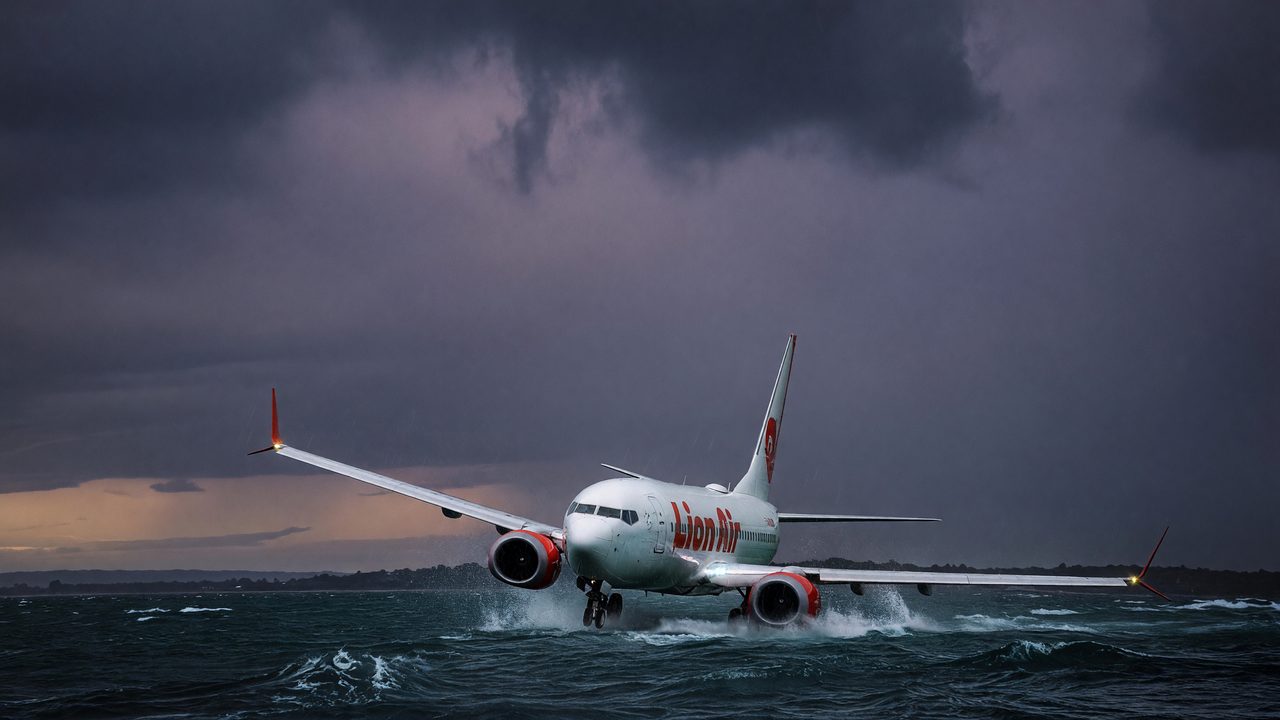
The Hidden Trim: How MCAS Broke a Certification Culture
When a single faulty angle-of-attack sensor met an automated flight-control system the FAA had certified as a minor change, 346 people died—and aviation spent twenty months learning what “delegated oversight” really costs.
Thirteen minutes over the Java Sea
On the morning of 29 October 2018, Lion Air Flight 610 climbed out of Jakarta with 189 souls aboard. Within minutes, a Boeing 737 MAX began fighting its own crew. Investigators would later trace the sequence to a left-side angle-of-attack vane feeding bad data into a software function Boeing had added to the MAX: the Maneuvering Characteristics Augmentation System, or MCAS. Designed to nudge the nose down during high-angle maneuvers, MCAS on early MAX software could activate repeatedly on a single sensor input. Each activation drove the horizontal stabilizer nose-down. Stop trimming manually, and the airplane trimmed itself again.
The crew never recovered. The aircraft struck the Java Sea at 06:31 local time. Four months later, on 10 March 2019, Ethiopian Airlines Flight 302 followed a chillingly parallel arc after takeoff from Addis Ababa—erroneous left AOA, stick shaker, uncommanded nose-down stabilizer motion, and a six-minute struggle that ended in terrain impact with 157 fatalities. The European Union Aviation Safety Agency, reviewing preliminary data, noted the same technical fingerprints linking both accidents. On 13 March 2019, an FAA Emergency Order of Prohibition under Acting Administrator Daniel Elwell grounded U.S.-registered Boeing 737 MAX aircraft and barred foreign MAX operations in U.S. airspace. A global fleet of roughly 387 airplanes went still.
A system regulators did not see coming
MCAS existed because larger LEAP engines changed the MAX’s pitch behavior near the stall. Rather than retrain every 737 pilot on new handling qualities, Boeing automated a correction. In certification, the function was not adequately highlighted to international validators as novel or safety-critical. The U.S. Department of Transportation Office of Inspector General, compiling a factual timeline of MAX certification at the Secretary of Transportation’s request, documented how Boeing applied for an amended type certificate in 2012 and how FAA oversight leaned heavily on delegated authority. In 2018, four U.S. aircraft manufacturers approved about 94 percent of certification activities on their own products through the Organization Designation Authorization program—an essential workload tool, but one whose limits would now face congressional scrutiny.
EASA’s independent return-to-service investigation found that process weaknesses allowed Boeing to miss the risk of relying on single-source AOA data. MCAS was classified as a “major” failure condition in the normal flight envelope—permitting less rigorous analysis than a “hazardous” or “catastrophic” rating would have demanded. Accident crews faced cascading alerts, stick shaker, and airspeed disagreements while MCAS worked in the background. They had not been trained on the system’s existence; Boeing’s assumptions about how quickly pilots would diagnose and defeat a runaway stabilizer did not match reality.
Twenty months of reckoning
What followed was not a routine airworthiness directive but a structural audit of modern certification. FAA’s public updates on the 737 MAX tracked months of simulator sessions, flight testing, and software iterations. EASA refused to rubber-stamp FAA conclusions, expanding its review from MCAS to the entire flight-control architecture, crew alerting, and wiring separation risks that original certification had not fully addressed. The reckoning stretched across more than twenty months—an unprecedented pause for a jet that had entered service barely eighteen months earlier.
The package required for return to service was deliberately layered. Boeing’s revised flight-control computer software—standard P12.1.2—limited MCAS to a single activation per elevated-AOA event, compared inputs from both AOA sensors before acting, and added monitoring to halt unintended nose-down trim. Physical wiring changes separated stabilizer command bundles. Manuals gained explicit runaway-stabilizer and MCAS language. Regulators mandated new computer-based and simulator training, including practical exercises on stabilizer trim and runaway recovery. EASA’s January 2021 closing report insisted the measures worked only as a complete set—software, hardware, procedures, and training together—not as isolated fixes.
Trust, rewritten
The MAX saga did not end at ungrounding. DOT OIG timelines and follow-on audits kept examining how FAA manages delegated certification on high-risk projects. EASA secured post-return commitments for further AOA integrity improvements and continued surveillance. For pilots, the lesson was blunt: an airplane can be legally certified, commercially successful, and aerodynamically familiar while hiding a control law that can overpower human inputs when sensors lie.
Why it matters to you
Every time you brief an unfamiliar type or drill runaway stabilizer recovery, you are practicing inside the gap MCAS exposed—the space between what regulators certify, what manufacturers assume about your workload, and what actually appears on your flight deck when automation misfires. The MAX reckoning did not argue against flight-control automation; it argued for transparency. You need to know which systems can move the trim without your command, which alerts may arrive in stacks rather than sequence, and which non-normal checklists remain the last line when software logic fails. Regulatory trust is not a substitute for aircraft knowledge. The twenty-month grounding made that contract explicit: certification culture now expects pilots to be trained partners in safety, not backup processors for assumptions buried in a type certificate. That is the standard you inherit in every jet transition course, every differences training module, and every sobering simulator session on trim runaway today.