The Forgotten Lock That Built Modern Aviation
"When forgetting one step nearly killed an industry"
The Forgotten Lock That Built Modern Aviation
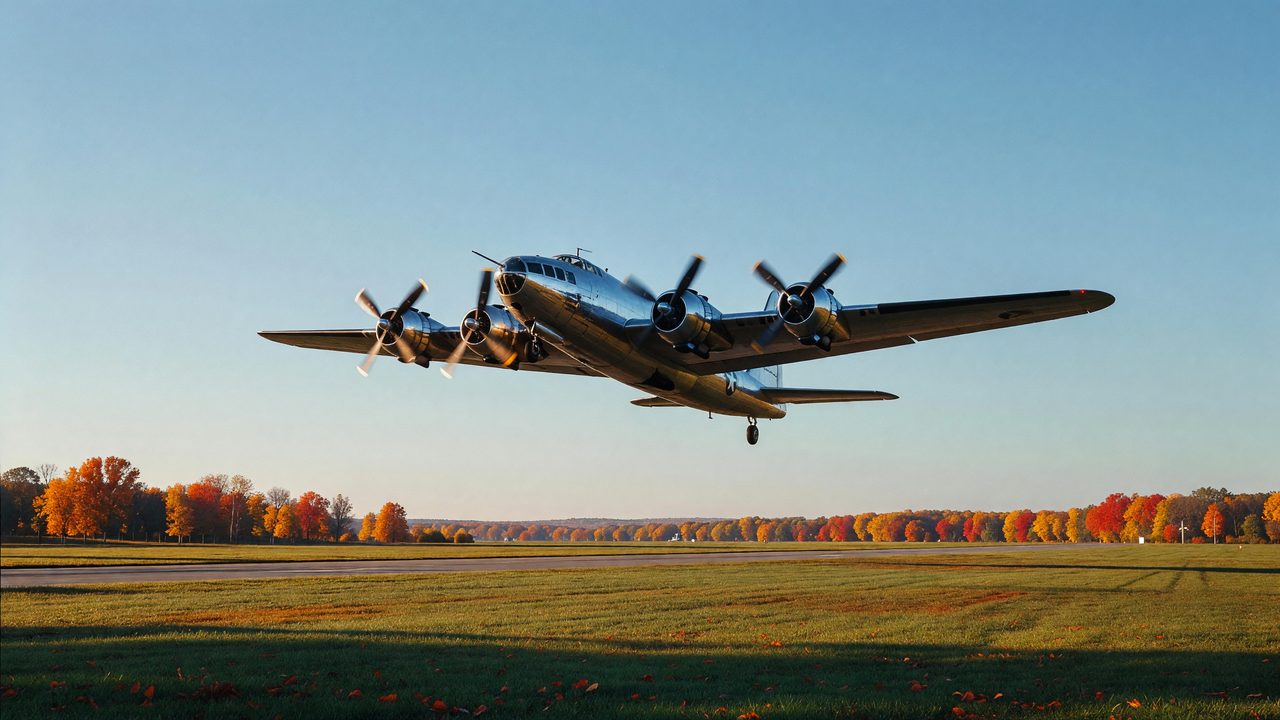
On a crisp October morning at Wright Field, a silver prototype bomber climbed three hundred feet and fell back to earth—teaching the Army Air Corps that even expert pilots cannot outrun complexity without a written ritual.
A Bomber Too Big to Remember
In the autumn of 1935, the U.S. Army Air Corps faced a procurement decision that would shape the coming war. Boeing, Martin, and Douglas each offered a long-range bomber prototype. The Boeing entry—designated Model 299, soon nicknamed the Flying Fortress—had already impressed evaluators at Wright Field in Ohio with its four engines, extended range, and heavy bomb load. Military observers gathered on October 30 to watch the gleaming aircraft perform another demonstration flight.
At the controls sat Major Ployer Peter Hill, the Air Corps’ chief of flight testing—a man whose résumé represented the pinnacle of institutional flying expertise. His copilot was First Lieutenant Donald L. Putt. Boeing’s chief test pilot, Leslie Tower, stood behind them in the spacious cockpit. Engineer John Cutting and mechanic Mark Koogler occupied the rear. Five men aboard a machine that embodied the future of American air power.
The Model 299 roared down the runway and lifted cleanly. Then, at roughly three hundred feet, something went terribly wrong. The nose pitched up too steeply. The aircraft stalled, rolled, and dove left wing low into the field. Fuel ignited on impact. Hill died in the wreckage. Tower survived the initial crash but succumbed to his burns. Putt, Cutting, and Koogler were pulled from the flames with injuries.
Nothing Wrong With the Airplane
A board of officers convened at Wright Field under Lieutenant Colonel Frank D. Lackland to determine what had destroyed Boeing’s ambitious prototype. Their findings exonerated the machine itself. There was no structural failure, no engine malfunction, no flaw in the automatic pilot or control-surface design. The direct cause was simpler and more unsettling: the elevator and rudder gust locks remained engaged.
The Model 299 employed internal locking mechanisms—a recent safety upgrade meant to protect tail surfaces from wind damage while parked, replacing the older practice of wedging wooden blocks against control surfaces. Investigators reconstructed the sequence with painstaking logic. The lock could not have been in its extreme “up” position, or the pilots could not have climbed into their seats. It could not have been fully “down,” or the aircraft would never have left the ground. The evidence pointed to an intermediate locked state that allowed takeoff but prevented Hill from lowering the nose when the climb grew too aggressive.
Tower, mortally wounded, confirmed what the wreckage implied: he had tried to reach the lock in flight. It was too late. As copilot Putt later recalled in testimony preserved by the Air Force Historical Foundation, neither he nor Hill had disengaged the internal pins before applying power. The finest pilots in the service had been defeated not by aerodynamics, but by a step omitted under pressure.
The Army’s Radical Answer
Critics seized on the crash as proof that the Model 299 was too complicated for human crews. Contemporary accounts cited in Air & Space Forces Magazine noted that preparing the bomber required dozens of discrete actions—perhaps thirty or more—far beyond what any pilot could reliably hold in working memory during a high-stakes evaluation watched by generals and executives.
The Air Corps might have abandoned the program. Instead, it identified the true limiting factor: not the aircraft’s size, but the fallibility of even expert memory. Working with their own test pilots, engineers devised a written checklist covering taxi, takeoff, flight, and landing. Each critical item would be read, verified, and acknowledged before the next phase of flight. The National Museum of the U.S. Air Force frames this shift as foundational: preflight protocols became the ingrained safety instinct of military, commercial, and private aviation worldwide.
The innovation worked. The Model 299 program continued. The aircraft entered service as the B-17 Flying Fortress and flew roughly 290,000 combat sorties across World War II—missions made possible, in part, by a discipline born the day Hill’s bomber fell at Wright Field.
Written in Blood, Flown Every Day
Aviation lore sometimes compresses history into a single moral: don’t forget the gust lock. The fuller lesson is structural. As aircraft grew from fabric-and-wire machines into multi-engine systems with hydraulics, turbochargers, and defensive armament, the cognitive load on crews expanded faster than individual talent could absorb. The checklist did not insult pilot skill; it extended it. What began as Army Air Corps paperwork in 1935 became challenge-and-response culture in cockpits from KC-135 tankers to Cessna trainers.
Major Hill’s name endures at Hill Air Force Base in Utah. Leslie Tower’s sacrifice is remembered less often. Together they stand at the origin of every laminated card clipped to a yoke, every electronic checklist on a glass cockpit, every captain’s call and first officer’s reply before rotation.
Why it matters to you
When you run a before-takeoff flow in a training aircraft—or call “airspeed alive” while your instructor verifies—you are practicing a habit with a specific birthday. Every checklist you touch traces its lineage to October 30, 1935, when a locked elevator proved that experience alone cannot substitute for disciplined procedure. The B-17 went on to fly 290,000 combat sorties in World War II, but that staggering number rests on a quieter statistic: countless flights that never made headlines because a crew caught the missed item on the ground. Treat your checklist not as bureaucracy but as inheritance. Read it aloud. Mean the responses. The lesson from Wright Field was purchased at three hundred feet; your job is to honor it at zero.