The Day the Sky Stopped Fighting Back
"He rode a bullet into history—on a broken rib."
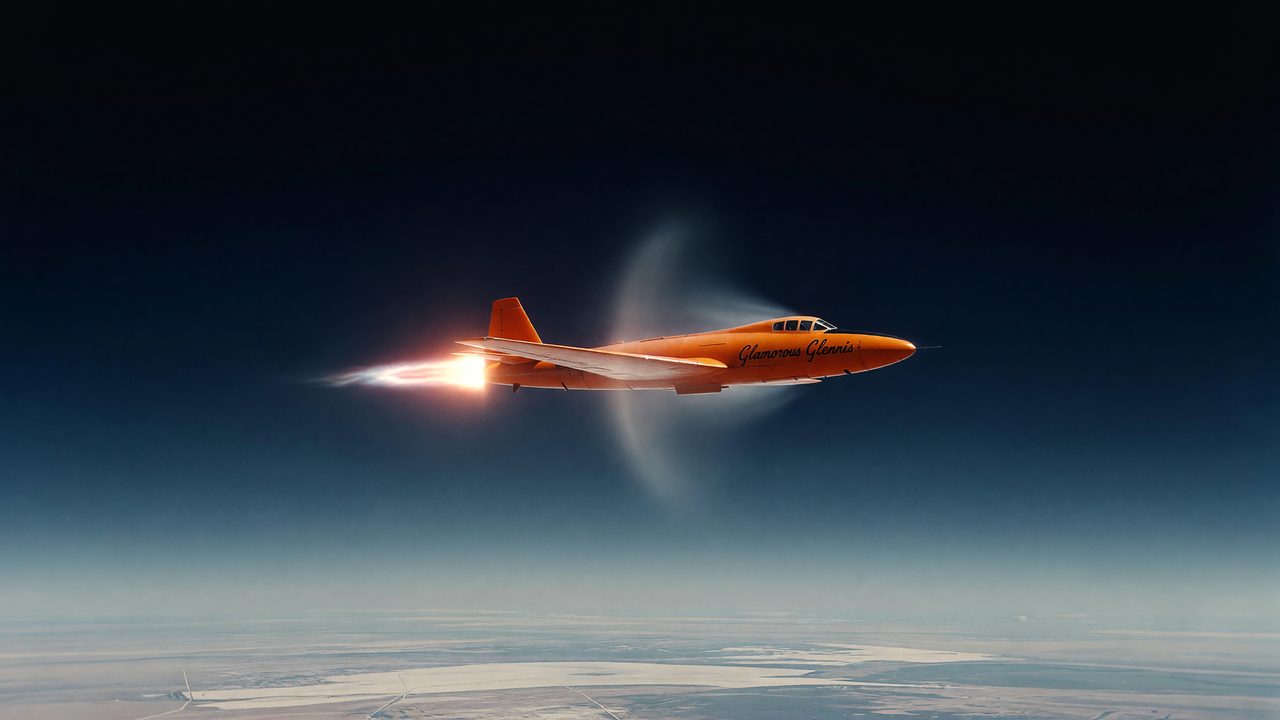
The Day the Sky Stopped Fighting Back
On a dry lakebed in California, a West Virginia fighter pilot and a bullet-shaped rocket plane proved that Mach 1 was a problem of engineering—not physics.
In the late 1940s, many serious people believed supersonic flight might be impossible. Aircraft approaching the speed of sound encountered violent buffeting, unpredictable control forces, and structural loads that seemed to worsen the faster they flew. Engineers spoke of a "sound barrier" as though the atmosphere itself might tear an airplane apart. Propeller-driven fighters of World War II had brushed against transonic speeds in dives, and some had not come home. The question was no longer academic. The jet age had arrived, and whoever mastered supersonic flight first would hold a decisive military advantage.
The U.S. Army Air Forces and the National Advisory Committee for Aeronautics—the predecessor to NASA—pursued the answer through a purpose-built research aircraft. The Bell X-1 resembled a .50-caliber bullet for a practical reason: high-powered rifle bullets were already known to remain stable well above the speed of sound. Its fuselage was slim, its wings thin and strong, and its four-chamber rocket engine delivered enough thrust for short, explosive climbs to altitude. Engineers also fitted the X-1 with a horizontally adjustable stabilizer, allowing minute changes in angle of attack that could tame the violent airflow of the transonic regime. Earlier X-1 flights had been brutal. This time, the modification made the difference.
Captain Charles E. "Chuck" Yeager was the man chosen to fly it. A World War II ace credited with 11.5 confirmed victories, he possessed the rare combination of instinctive stick-and-rudder skill and the ability to translate what he felt in the cockpit into usable data for the engineers on the ground. He had named the orange rocket plane Glamorous Glennis after his wife. On the morning of October 14, 1947, he climbed aboard at Rogers Dry Lake in the southern California desert under circumstances that would have grounded most pilots. Two nights earlier, a horseback riding accident had cracked two of his ribs. He told almost no one. His flight engineer, Jack Ridley, fashioned a workaround: he sawed a ten-inch piece from a broomstick so Yeager could use his left hand to pull the hatch closed—an awkward motion his injured right side could not manage alone.
The flight profile was unlike anything in ordinary aviation. A Boeing B-29 Superfortress carried the X-1 aloft in its bomb bay. After a thirty-minute climb to 20,000 feet above the lakebed, the rocket plane dropped free. Yeager ignited the Reaction Motors XLR-11 engine and climbed under power to 42,000 feet, where he began his speed run. It was the 50th flight of the X-1 program, and Yeager’s ninth powered flight in the aircraft. The Mach meter crept upward through the high subsonic range—then, in a moment that would define aviation history, jumped from Mach 0.965 to Mach 1.06. The transition was startling on the instruments and almost imperceptible in the seat. The buffeting that had plagued earlier attempts simply did not return. Yeager had flown faster than sound.
He burned rocket fuel for roughly twenty seconds, then shut the engine down and glided to a landing on the dry lake. From release to touchdown, the world's first piloted supersonic flight lasted fourteen minutes. The Air Force and NACA had their data. The invisible wall many had feared was gone.
Yeager himself understood that the achievement was only a beginning. As he later reflected, the real barrier "wasn't in the sky but in our knowledge and experience of supersonic flight." The X-1 program would fly seventy-eight times in all, reaching speeds above Mach 1.4 and altitudes approaching 72,000 feet. Its findings flowed directly into the next generation of combat aircraft built as the Cold War hardened. Among them was the North American F-100 Super Sabre, America's first operational supersonic fighter—an airplane whose tail design owed a direct debt to the adjustable stabilizer Yeager had used over Rogers Dry Lake.
Why it matters to you
You will never fire a rocket engine at 42,000 feet, but the lesson Yeager's flight encoded is one every pilot trains for: control authority changes with airspeed, and the transition through high subsonic speeds demands respect. In the transonic regime, airflow over the wing and tail behaves differently than your POH diagrams suggest, and control surfaces can lose effectiveness precisely when loads are highest. The X-1's adjustable horizontal stabilizer solved that problem by letting the pilot trim the tailplane independently of the elevator—preserving control when it mattered most. That solution did not stay locked in a museum. It migrated into supersonic fighters like the F-100 and, in subtler form, into the design philosophy of every high-performance aircraft that followed. When you practice precise speed control on final, study how trim affects stability at different configurations, or learn why Vne exists, you are working in the tradition of a flight test community that refused to accept an atmospheric limit without first measuring it. Chuck Yeager did not defeat the sky. He defeated uncertainty—and that is the kind of barrier every rated pilot is trained to clear.