Ten Minutes Past the Line
"Twenty-one years after he had founded the company in a Se..."
Ten Minutes Past the Line
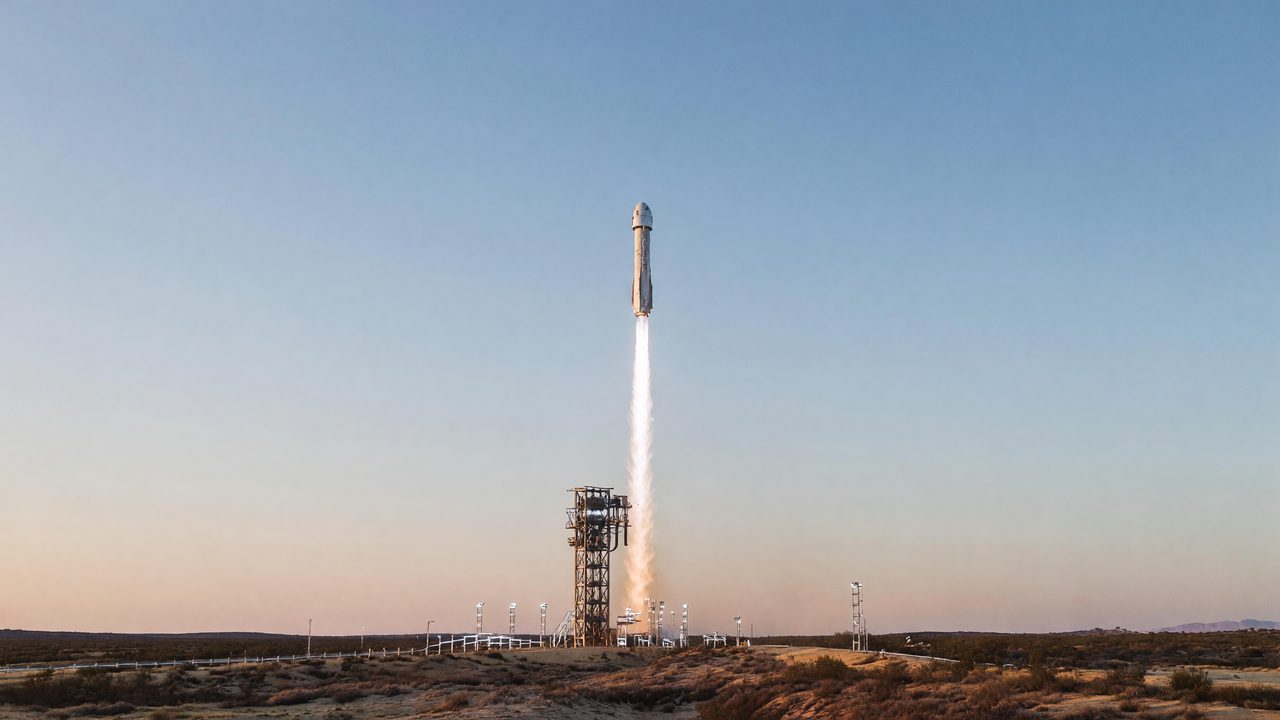
On 20 July 2021, a hydrogen rocket lifted four civilians above the Kármán line—and proved that privately funded spaceflight had become a licensed, ticketed business.
The Warehouse and the Ranch
In 2000, Jeff Bezos founded Blue Origin in a Seattle warehouse with a long-horizon ambition: make space accessible and preserve Earth for future generations. Twenty-one years later, he climbed aboard his own spacecraft at Corn Ranch near Van Horn, Texas—a remote West Texas launch site chosen for clear airspace and operational simplicity, much as early aviation pioneers sought open fields before paved runways existed.
The flight was New Shepard’s sixteenth overall and its first carrying passengers. Blue Origin’s press updates for “First Human Flight” documented a deliberate schedule: liftoff at 08:11 CDT on 20 July 2021, timed to coincide with the fifty-second anniversary of the Apollo 11 lunar landing. The symbolism was unmistakable. A new chapter in human spaceflight would share a calendar page with the mission that first put boot prints on the Moon.
Four Seats, One Business Model
Inside the capsule rode four people with four different stories. Bezos and his brother Mark flew as founder and family. Wally Funk, eighty-two years old and a member of the Mercury 13 group of female astronaut candidates from the early 1960s, had waited decades for a chance that never came through NASA’s ranks; on this hop she became the oldest person to fly in space. Eighteen-year-old Oliver Daemen, flying in place of an auction winner who had a scheduling conflict, became the youngest—and, as contemporaneous reporting from Spaceflight Now and NASASpaceFlight.com noted, the first commercial astronaut to purchase a ticket on a privately funded, licensed vehicle.
That last detail matters. This was not a government-selected crew on a national program. It was a paying customer on a commercial suborbital line, operated under FAA licensing like the airlines and charter operators pilots already know from the regulatory world—only the flight regime and the vehicle were entirely new.
BE-3, the Kármán Line, and the View
Propulsion came from the BE-3, a hydrogen-fuelled engine designed for restart and precision throttle control—engineering choices that echo the discipline every pilot learns in power management: match thrust to mission phase, conserve energy where you can, and recover cleanly. The stack climbed past the Kármán line, the widely cited boundary near one hundred kilometres separating aeronautics from astronautics, and reached approximately 107 kilometres before the capsule separated for its ballistic arc.
Crews experienced roughly three minutes of weightlessness—brief, but long enough to unstrap and float. Through the largest windows yet flown on a crewed spacecraft, they saw Earth’s curvature and the thin blue line of atmosphere that every aviator studies on weather charts and cross-country flights, only now without an aircraft fuselage between them and the planet. BBC News and other live coverage described the profile as a suborbital hop of about ten minutes from ignition to soft landing under parachutes in the Texas desert, with the reusable booster returning separately under its own powered descent.
From Demonstration to Industry
Blue Origin had spent two decades testing incrementally—uncrewed flights, booster landings, capsule aborts—before putting humans on board. That methodical cadence mirrors how aviation matured: prove the machine, then the procedure, then the operator, then the paying passenger. In a single morning, the company showed that suborbital space tourism was no longer a deferred dream confined to concept art and science fiction. It was a business with a manifest, a license, and a price tag.
The flight did not open deep space or replace orbital logistics. It did something quieter and perhaps more durable for general aviation’s cousin industry: it normalized the idea that private capital, private vehicles, and private crews could cross the same threshold only superpowers and selected professionals had crossed before.
Why it matters to you
The engineering principles on display that July morning—closed-loop propulsion management, structural margins for launch and recovery loads, human factors in a pressurized cabin, and procedural discipline under time-critical phases—are the same families of skills you train every time you brief a flight, manage fuel and power, respect V-speeds and load limits, and rehearse abnormal procedures until they are reflex. New Shepard’s hydrogen engine, its reusable booster, and its capsule’s descent under canopy all descend from a century of aerospace problem-solving that flows directly into the aircraft you fly: materials science, aerodynamics, systems redundancy, and the relentless habit of verifying performance before you carry souls aloft. Bezos’s ten-minute hop was not a detour from aviation history. It was aviation history bending upward—reminding every pilot that the atmosphere you master is only the first layer, and that the craft of flying well on Earth is preparation for flying wisely wherever humans go next.