Quiet at Moses Lake: Alice Rewrites the Commuter Equation
"500 feet"
Quiet at Moses Lake: Alice Rewrites the Commuter Equation
On a September morning in central Washington, a fixed-wing electric airliner proved that sustainable regional aviation need not wait for rotors, rockets, or science-fiction promises.
The desert air over Grant County International Airport holds a particular stillness at dawn. Runways that once hosted B-52 training sorties and heavy jet certification work now see a different kind of experiment: aircraft built for communities that want connectivity without the acoustic and environmental cost of turbine commuters. At 07:10 local time on 27 September 2022, that experiment left the ground.
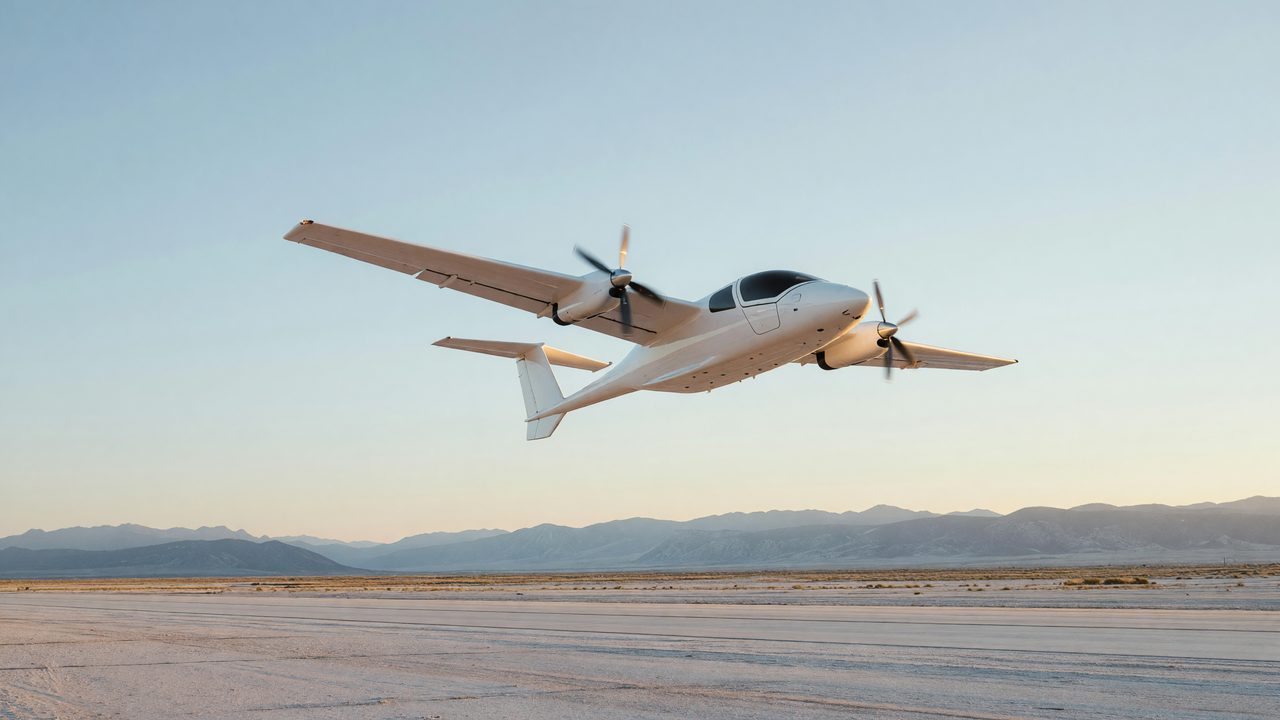
Eviation’s Alice rose from Moses Lake on its maiden flight—a sleek white airframe with a T-tail and electric propulsion units mounted on the aft fuselage in a pusher configuration. The aeroplane climbed to 3,500 feet and flew for eight minutes before returning to land. Eight minutes is modest by airline standards, yet for a programme staking its credibility on an entirely new propulsion architecture, those minutes carried disproportionate weight. This was not a converted piston twin or a hybrid demonstrator. Eviation had designed Alice from the keel up as an all-electric commuter, and the company’s own announcement framed the event as the first flight of an all-new, all-electric aircraft built for commercial service.
The distinction matters in a sector crowded with electric vertical take-off and landing concepts. eVTOL projects dominate headlines and venture capital slide decks, promising rooftop hops and urban air mobility networks that remain largely unbuilt. Alice takes the opposite bet: conventional fixed-wing geometry, runways pilots already know, and a mission profile that mirrors today’s regional airlines—nine passengers and two crew on stage lengths roughly between 150 and 250 nautical miles. Eviation’s stated ambition is zero-emission operations with a noise footprint low enough to satisfy airports bound by strict curfews. For towns that have watched scheduled service evaporate when turboprop economics turned sour, that combination—quiet, short-field-friendly, and electrically powered—targets the pain directly.
Propulsion comes from magniX electric units, integrated into an airframe that treats energy storage as structural architecture rather than ballast stuffed into a legacy fuselage. Battery packs are woven into the aircraft’s load-bearing design, a fundamental rethink of how weight, centre of gravity, and crashworthiness interact in a certified transport category aeroplane. Aft-mounted distributed electric propulsion on the empennage further signals intent: distributed electric thrust allows designers to shed some of the mechanical complexity that binds traditional commuters to single-engine or wing-mounted turboprop installations. The T-tail and clean lines visible at Moses Lake are not styling exercises; they reflect aerodynamic and operational choices made around propeller disc clearance, ground handling, and the thermal management demands of high-power electrics.
Grant County International is no random test site. Moses Lake’s long runways, sparse traffic, and aerospace-industry familiarity made it a practical crucible—close enough to Eviation’s Pacific Northwest engineering base, yet spacious enough for early envelope expansion without threading Seattle’s Class B airspace on a first flight. Local reporting from The Seattle Times placed the event in that regional context: another chapter for an airport that has long served as a proving ground when new aircraft need room to learn.
On the ramp afterward, Eviation President Gregory Davis told gathered staff and observers that humanity had “electrified the skies.” Press releases distributed the same day through Eviation and PRNewswire carried the milestone language certification-minded investors expect—first flight achieved, development continuing. Davis’s rhetoric was aspirational, but the flight data were concrete: wheels up, controlled climb, stable cruise segment, safe recovery. For student pilots trained to treat every first flight as a disciplined exercise in energy management and systems knowledge, the parallel is obvious. A new type enters the pattern cautiously, proves controllability, and only then earns the right to longer missions.
Certification, as Eviation acknowledged implicitly by characterising the flight as a milestone rather than a product launch, remains years distant. Battery energy density, thermal runaway mitigation, dispatch reliability, and the FAA’s evolving special conditions for novel propulsion will govern the timeline more than any single successful hop. Yet the Moses Lake flight established something eVTOL renderings cannot: a nine-seat commuter-class aeroplane, looking recognisably like the aircraft in ground-school textbooks, flew under electric power alone.
Why it matters to you
The engineering principles Alice is pioneering—integrated battery structure, distributed electric thrust, and energy budgeting as a first-order flight-planning constraint—are already reshaping how pilots think about aircraft systems even in conventionally fuelled cockpits. Every time you calculate fuel reserves, manage single-engine performance, or study how weight and balance shift with payload, you are practising the same discipline electric commuters must master at scale: energy is finite, placement affects handling, and propulsion architecture drives operational limits. When electric aircraft eventually join regional ramps, pilots who learned those lessons on today’s trainers and twins will not be starting from zero. They will be extending skills the industry has taught for a century—just with quieter motors on runways that have served communities since before anyone spoke of electrifying the skies.