From Rooftop Dream to Runway Reality
"000 miles"
From Rooftop Dream to Runway Reality
Joby Aviation has turned the electric air taxi from concept art into certifiable hardware—and the milestones are stacking up fast.
For decades, the idea of a quiet electric aircraft lifting straight off a city rooftop, tilting into wing-borne cruise, and delivering passengers across town in minutes belonged to the future tense of aviation. Joby Aviation, founded by JoeBen Bevirt in 2009 in California, set out to pull that future into the present. The company flew its first full-scale prototype in 2017—the same year it demonstrated the first transition of a full-scale aircraft from vertical flight to wing-borne cruise, initially under remote control. What followed was not a publicity sprint but a long, methodical test campaign. By 2025, Joby reported more than 40,000 miles flown across its fleet, a distance the company describes as the longest accumulated by any electric vertical takeoff and landing programme.
Building the machine
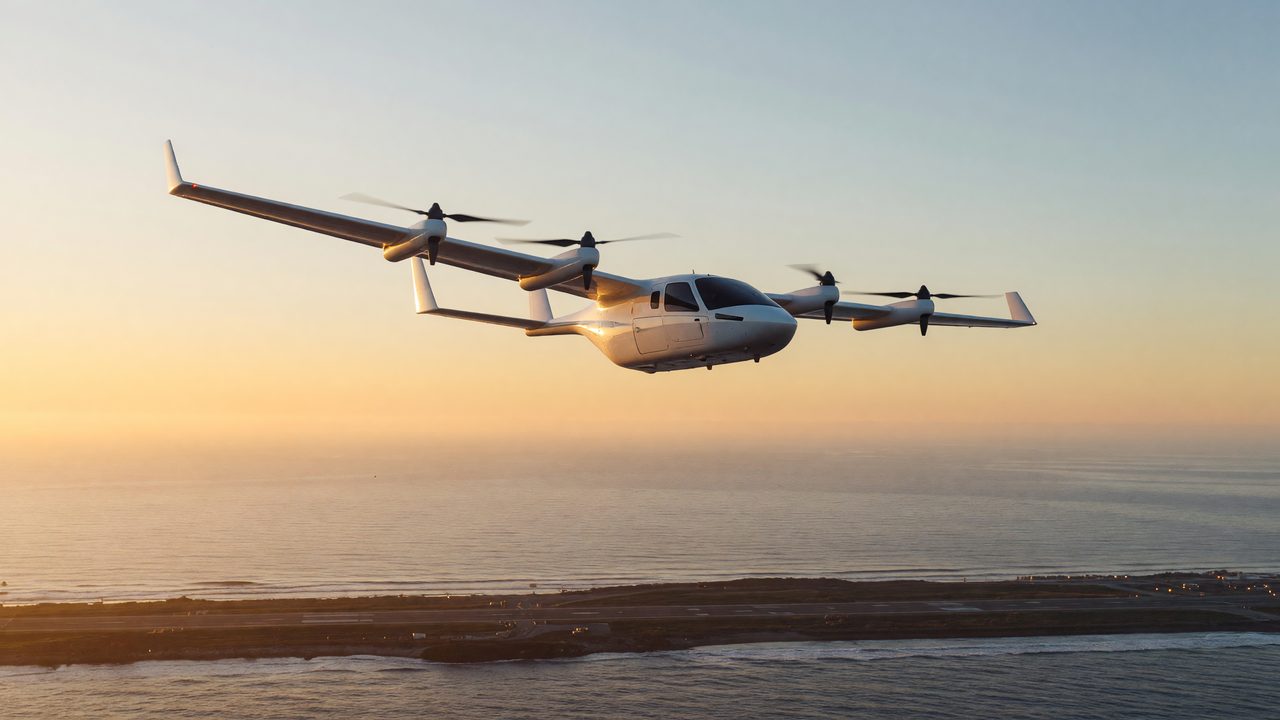
The aircraft itself is a tilt-propeller design: six electric motors on tilting nacelles allow vertical lift on departure and arrival, then efficient forward flight on a fixed wing. Joby intends the production aircraft to carry a pilot and up to four passengers at speeds up to 200 mph, with zero operating emissions and noise levels well below those of a conventional helicopter. That performance envelope matters because urban air mobility lives or dies on public acceptance—an aircraft that cannot hover quietly over neighbourhoods or integrate with existing traffic patterns will never reach the vertiport.
Manufacturing moved from prototype to production in June 2023, when Joby received a Special Airworthiness Certificate from the Federal Aviation Administration for the first aircraft built on its pilot production line in Marina, California. Built in collaboration with strategic partner Toyota, that airframe marked a shift from experimental hardware toward repeatable assembly under a released design and quality management system—the same industrial discipline that separates a flying demonstrator from a certifiable transport category aircraft.
The transition that changed everything
The hardest manoeuvre in any tilt-wing or tilt-rotor programme is the transition itself: the moment when lift transfers from rotors to wing, airflow reorganises around the airframe, and the pilot must manage pitch, power, and attitude through a regime that has no analogue in conventional fixed-wing or rotary training. Joby had logged hundreds of remotely piloted transitions and more than a hundred piloted flights in hover and low-speed work before attempting the full cycle with a human at the controls.
On 22 April 2025, Chief Test Pilot James “Buddy” Denham became the first pilot to complete that full transition—vertical takeoff, acceleration to wing-borne cruise, deceleration, and vertical landing—with a pilot aboard. Denham, a retired Naval Air Systems Command engineer who had helped develop the unified control concept later integrated into the F-35B, flew the manoeuvre in aircraft N544JX from Joby’s Marina production line. Within days, the company reported routine inhabited transition flights with three different pilots at the controls—the first operator, it claimed, to perform such testing as standard practice rather than a one-off stunt. Joby announced the achievement in an April 2025 press release, framing it as the gateway to Type Inspection Authorization flight testing with FAA pilots onboard.
Into the national airspace
Laboratory success does not equal operational readiness. On 15 August 2025, Joby closed that gap by flying between two public airports for the first time: Marina Municipal (OAR) and Monterey Regional (MRY), roughly ten nautical miles apart along the California coast. The piloted flight lasted about twelve minutes and included five minutes in a holding pattern at Monterey while sequencing with other traffic—demonstrating, in FAA-controlled airspace, that the aircraft could obey the same arrival procedures as the airliners sharing the pattern. Vertical takeoff, transition to cruise, integration into controlled airspace, and vertical landing were all part of a single sortie conducted away from Joby’s home base, with full mobile ground support. The company called it the first piloted eVTOL air taxi flight between two public airports—a claim that, if it stands, moves urban air mobility from fenced test ranges into the airspace every rated pilot already knows.
The certification runway
Regulatory progress has kept pace with flight testing. In December 2024, Joby became the first eVTOL manufacturer to enter Type Inspection Authorization, the FAA’s final phase of type certification before commercial passenger operations. That milestone began with simulator trials in which four FAA test pilots evaluated human factors elements of the flight deck—workload under varied flight conditions, ergonomics, and other safety-critical interfaces—using an FAA-conforming cockpit. TIA flight testing with conforming aircraft was targeted for 2025, with domestic commercial service planned for Los Angeles and New York City after certification. Dubai remains the announced launch market, with passenger operations scheduled for 2026.
Why it matters to you
The engineering principles Joby is proving—tilt-prop transition management, electric propulsion redundancy, and seamless integration into controlled airspace—are extensions of skills you already train. Every transition flight Denham flew demanded the same disciplined energy management and mode awareness you practice when configuring an aircraft for approach, except the configuration change happens in three dimensions at low altitude. Every hold at Monterey was ordinary IFR sequencing: listen, comply, maintain separation. When eVTOLs eventually share your frequency, the phraseology will be familiar even if the silhouette is not. Understanding how these aircraft earn their place in the NAS makes you a better participant in the airspace of the next decade—not a spectator watching science fiction take off from the ramp next door.