Feather First: How Burt Rutan’s SpaceShipOne Broke the Government Monopoly on Space
"Until 21 June 2004, every human who had travelled beyond ..."
Feather First: How Burt Rutan’s SpaceShipOne Broke the Government Monopoly on Space
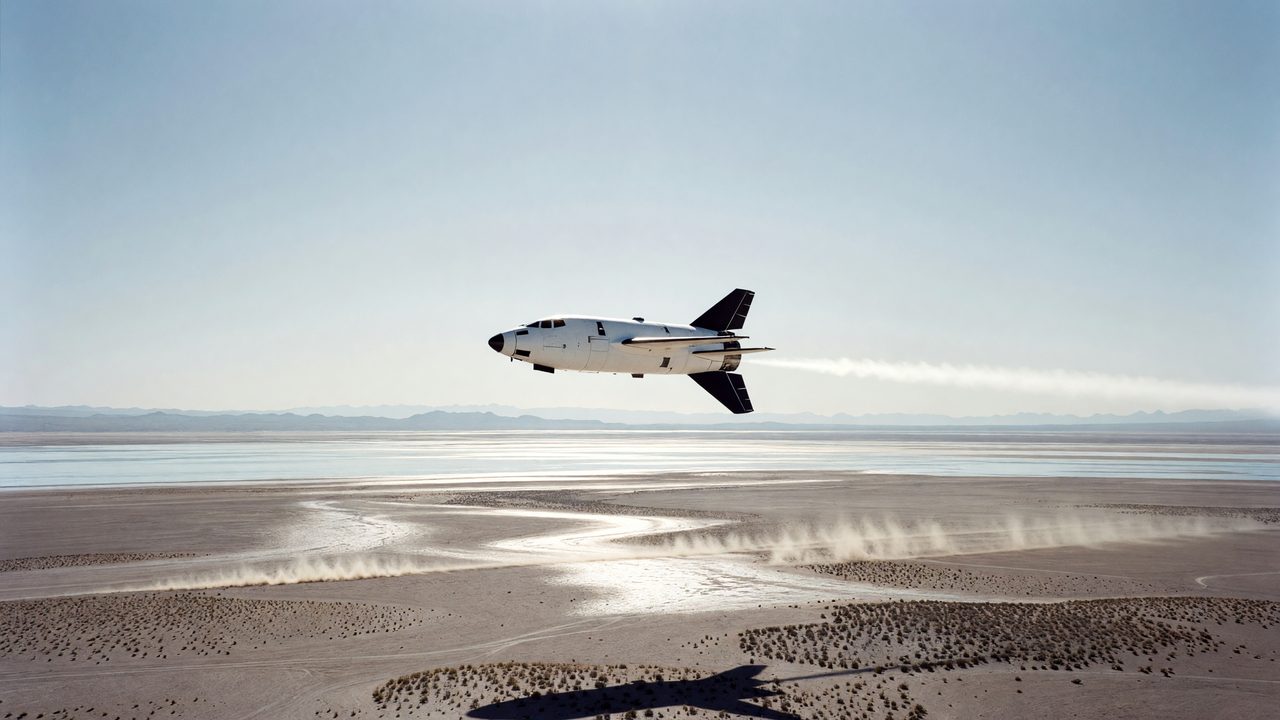
On a June morning over the Mojave Desert, a homebuilt rocket plane proved that private citizens could reach the edge of space—and return alive using a tail that folded upward like a shuttlecock.
Until 21 June 2004, every human being who had crossed the threshold of space had ridden a government rocket. Alan Shepard’s Mercury capsule, Gus Grissom’s Liberty Bell, Joe Walker’s X-15—all were national programs, funded by taxpayers and flown under military or civilian agency authority. That monopoly ended at 7:50 a.m. Pacific time, when test pilot Mike Melvill fired the hybrid rocket motor aboard SpaceShipOne moments after flight engineer Matt Stinemetze released it from the belly of the White Knight carrier aircraft at 47,000 feet above the Mojave Desert.
Designed by Burt Rutan at Scaled Composites and financed through Paul Allen’s Vulcan Inc. under the Mojave Aerospace Ventures banner, SpaceShipOne was never meant to imitate NASA. Rutan’s program summary for the Tier One effort described a near-vertical boost trajectory, a shirt-sleeve cabin, and a runway landing at 75 knots—deliberately unlike the X-15’s steep, pilot-intensive entry profile and lakebed touchdowns. The spacecraft’s signature innovation was the feathered reentry: pneumatic actuators rotated the twin tail booms and rear wing section upward to roughly 65 degrees, transforming the craft into a high-drag, high-angle-of-attack configuration that Rutan called “care-free.” Aerodynamic controls became ineffective during entry, but the pilot did not need them. Trim managed azimuth; pitch and roll were passive. Dynamic pressure during descent reached only about 15 percent of what the X-15 endured at comparable altitudes, keeping thermal loads and structural stress within limits a small composite airframe could survive.
Melvill’s 76-second burn pushed SpaceShipOne past 2.9 Mach and into a coast that topped out at 328,491 feet—100.124 kilometres, clearing the internationally recognised space boundary. He floated weightless for three and a half minutes, then rode the feathered descent back through the atmosphere. The flight was historic, but it was not flawless. Late in the boost phase, the primary pitch-trim system failed. Melvill switched to the backup and pressed on, though the trajectory deviation left the ship re-entering south of the planned recovery corridor. Scaled Composites’ own Tier One test logs record the event without understatement: any flight-control anomaly is serious. SpaceShipOne glided home to Mojave anyway, demonstrating both the margins Rutan had built in and the composure expected of an experimental test pilot.
The Ansari XPRIZE, launched in 1996 with a $10 million purse, demanded more than a single spectacular hop. A privately funded, reusable craft had to carry the equivalent of three people above 100 kilometres twice within two weeks, replacing no more than 10 percent of non-fuel mass between flights. After months of analysis and trajectory refinement, the team returned to the desert. On 29 September 2004, Melvill flew the first qualifying mission to 103 kilometres, surviving a wild rolling departure near the end of the burn—roll rates that peaked near 190 degrees per second in thinning air where aerodynamic controls alone could not recover the ship. He damped the motion with reaction-control thrusters before apogee. Five days later, on 4 October 2004—the forty-seventh anniversary of Sputnik—Brian Binnie took the controls. His 83-second burn reached 3.09 Mach and an apogee of 367,500 feet, or 112 kilometres, setting an FAI class record and exceeding the X-15’s altitude mark by 13,000 feet. Binnie feathered, retracted at 51,000 feet, and landed at Mojave with no maintenance squawks. Mojave Aerospace Ventures claimed the prize. SpaceShipOne was retired immediately, installed in the Smithsonian National Air and Space Museum’s Milestones of Flight gallery in October 2005, and its technology licensed to Richard Branson’s Virgin Galactic—proof, as the XPRIZE Foundation would later document, that a $10 million competition could catalyse a commercial space industry once dismissed as fantasy.
Why it matters to you
You will never feather a tail at Mach 3, but the disciplines that kept Melvill and Binnie alive are the same ones your instructor drills on a Cessna 172. Know your backup systems before you need them—Melvill’s pitch-trim failure during the first spaceflight was survivable only because redundancy was designed in, not improvised in the moment. Respect control authority limits at the edge of the envelope; the September roll excursion traced directly to a flight regime where directional stability vanished and dihedral effect converted yaw into an uncontrollable roll. Understand configuration management: Rutan’s feather was a deliberate mode change that traded aerodynamic finesse for stability, much as you extend flaps or deploy speed brakes to shift an aircraft into a predictable energy state. Finally, absorb the flight-test ethos Scaled Composites embodied—identify the anomaly, analyse it, adjust the procedure, and fly again. That cycle turned a hair-raising June morning into an October prize flight that changed who gets to go to space. The frontier, Rutan’s team demonstrated, was no longer the exclusive province of nations. It was the province of anyone stubborn enough to engineer a solution and skilled enough to fly it home.