Baby Boom Breaks the Silence
"120 feet"
Baby Boom Breaks the Silence
Twenty years after Concorde’s last landing, a Colorado startup proved that civil supersonic flight could rise again—not from a government lab, but from a desert runway where aviation history was written twice.
The Mojave Takes Off Again
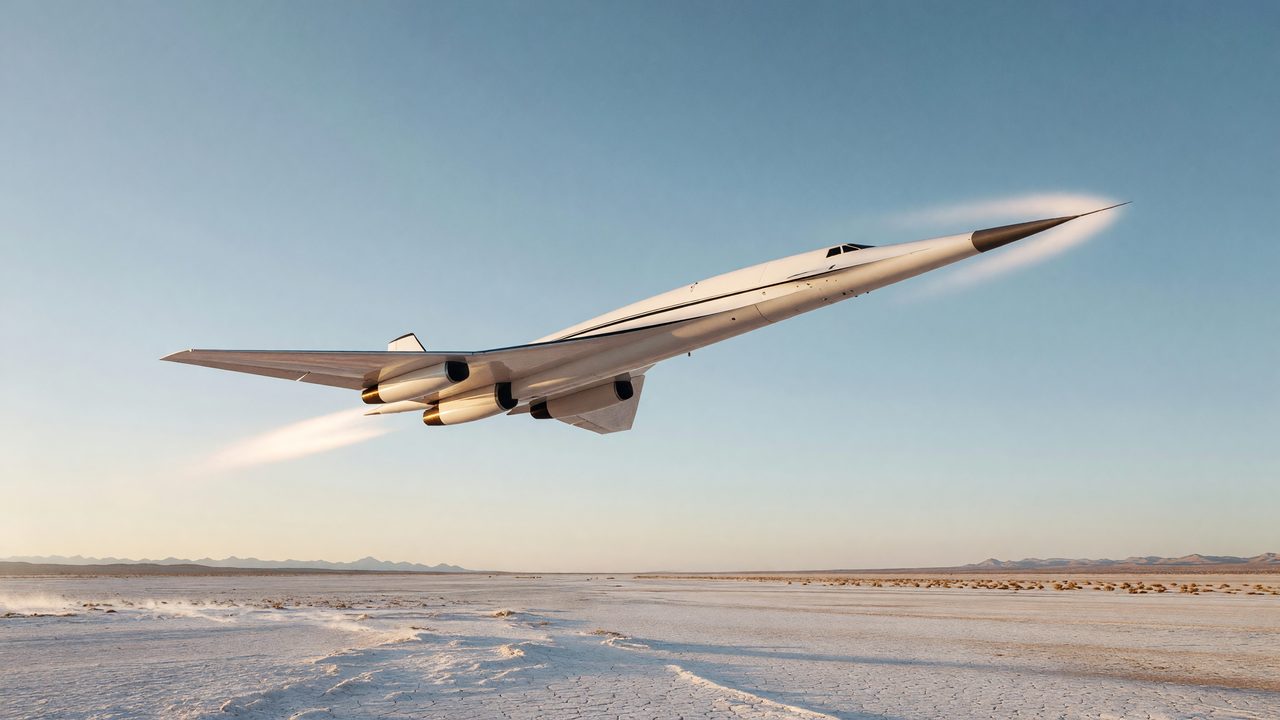
When the last Concorde touched down at Bristol Filton in November 2003, many pilots assumed they had witnessed the final chapter of passenger supersonic flight. That assumption lasted two decades. On 22 March 2024, at 07:28 PDT, Boom Supersonic’s XB-1 demonstrator—nicknamed “Baby Boom”—lifted from Mojave Air & Space Port into the same California desert airspace where Chuck Yeager’s Bell X-1 first cracked the sound barrier in October 1947.
Chief Test Pilot Bill “Doc” Shoemaker held the controls of the compact trijet as it climbed to 7,120 feet and accelerated to 246 knots during a twelve-minute hop. The flight was deliberately modest. Boom’s engineers were not chasing records; they were confirming that a carbon-fibre airframe, variable-geometry supersonic inlets, and digitally optimised aerodynamics could behave predictably in the hands of a human pilot before anyone asked passengers to board. As the company noted in its inaugural-flight announcement, XB-1 met every test objective that morning, including handling checks alongside a T-38 chase aircraft flown by Tristan “Geppetto” Brandenburg—who would later take the jet through Mach 1 himself.
The moment registered beyond the flight-test community. Reporters who had tracked years of delays watched a privately funded demonstrator leave the ground where Lockheed’s SR-71 and North American’s X-15 had once been wrung out, and wondered aloud whether commercial supersonic travel might finally return.
Through the Sound Barrier—Without a Government Badge
Subsonic envelope expansion consumed the better part of a year. Between August 2024 and January 2025, XB-1 flew eleven additional missions, each one widening the aircraft’s certified flight envelope while a disciplined test team treated safety as the programme’s governing constraint—the same incremental philosophy that governs every Part 23 or Part 25 certification campaign, only pushed toward a number most general-aviation pilots never touch: Mach 1.
On 28 January 2025, Brandenburg entered the supersonic corridor above Mojave, climbed to 35,290 feet, and accelerated to Mach 1.1. Boom’s flight log records the achievement as Flight 12 of thirteen: the first time a privately developed jet aircraft broke the sound barrier, and the first human-piloted civil supersonic flight since Concorde’s retirement. Historically, that threshold belonged to national programmes backed by military budgets and state treasuries. XB-1 crossed it with a startup’s payroll and a desert runway.
Twelve days later, on 10 February 2025, Brandenburg repeated the run on Flight 13, pushing to Mach 1.18 before the programme declared victory. XB-1 was retired and moved to Boom’s Denver headquarters, its mission complete. In thirteen flights spanning less than a year, the slender demonstrator had served its purpose: not to carry fare-paying travellers, but to function as a flying wind tunnel for the airliner that might.
A Flying Laboratory for the Airliner Ahead
Every technology XB-1 validated was chosen because Overture will need it at scale. Carbon-fibre composites keep weight down while preserving the slender fuselage and refined wing geometry that supersonic cruise demands. Computational fluid dynamics let engineers explore thousands of aerodynamic shapes before metal—or composite—was ever cut. Variable-geometry inlets slow supersonic airflow to subsonic speeds at the engine face, converting kinetic energy into pressure so conventional turbofan cores can breathe from take-off roll through transonic acceleration.
XB-1 also carried an augmented-reality vision system: nose-mounted cameras feeding a high-resolution display so pilots could see the runway despite the aircraft’s high nose attitude on approach—eliminating the need for Concorde’s famous drooping nose. Digital stability augmentation, meanwhile, helped maintain controlled flight across an envelope where aerodynamic forces shift rapidly. None of these innovations will remain confined to Mojave. They are the same families of tools—composite structures, CFD-driven design, digital flight-control augmentation—that already shape the trainers and turboprops most pilots fly today.
Overture: Orders on the Books, Factory on the Ground
The commercial prize is Overture, Boom’s planned 64- to 80-seat airliner designed to cruise at Mach 1.7 on up to 100 percent sustainable aviation fuel. American Airlines, United Airlines, and Japan Airlines have collectively placed 130 orders and pre-orders. Construction of the Overture Superfactory in Greensboro, North Carolina—a facility scaled to produce 66 aircraft per year—proceeded in parallel with XB-1’s flight-test campaign. The demonstrator’s retirement did not signal retreat; it signaled transition from proof-of-concept to production engineering, with Symphony, Boom’s purpose-built turbofan, advancing on its own test schedule.
Whether Overture meets its target of entering airline service before the decade ends remains an open engineering and certification question. What XB-1 settled is more fundamental: the economics and aerodynamics of supersonic travel need not wait for another Anglo-French consortium. A private company with a dream, a disciplined test culture, and a runway in the California desert can reopen a chapter that many assumed had closed forever.
Why it matters to you
You may never hand-fly a Mach pass in a T-38 chase ship, but the discipline behind XB-1’s envelope expansion is the discipline behind every certificate you earn. Test pilots expanded the flight envelope one careful increment at a time—confirming handling, verifying systems, and refusing to outrun their data. That is precisely the mindset your instructor drills when you fly slow flight, stalls, or your first cross-country: understand the aircraft’s behaviour at the edge of the known envelope before you ask more of it. The composites, CFD-optimised wings, and digital stability augmentation pioneered in Mojave are already embedded in the aircraft you fly today, making them lighter, more efficient, and more predictable. Supersonic flight may sit at the far end of your logbook, but the engineering habits that made XB-1 possible—methodical, data-driven, safety-first—are the habits that keep every pilot, from student to airline captain, alive in the cockpit.