Asiana Flight 214: When the Machine Stopped Watching
"The mode annunciator showed HOLD. Four pilots saw nothing. The seawall saw everything."
Asiana Flight 214: When the Machine Stopped Watching
On a clear July morning at San Francisco, a Boeing 777 carried four pilots in the cockpit — and still flew itself into a seawall because nobody was watching what the autothrottle had stopped doing.
The visual approach to Runway 28L should have been routine. Asiana Airlines Flight 214, a Boeing 777-200ER arriving from Seoul on July 6, 2013, was cleared for a straight-in visual under bright Pacific daylight. Controllers vectored the crew onto final about fourteen nautical miles from the threshold, slightly above the three-degree glidepath. Then came a speed assignment: maintain 180 knots until five miles out. That instruction, combined with the crew’s own descent management, left the airplane high and fast as it closed on the airport.
What followed was not a sudden mechanical failure but a slow erosion of control. The pilot flying, attempting to steepen the descent and recapture the glidepath, selected FLCH SPD — flight level change speed — on the autoflight system. Because the 777 was below its selected altitude, the mode did not increase descent rate as intended. Instead, the autoflight system commanded a climb. The pilot flying disconnected the autopilot, retarded both thrust levers to idle, and pitched the nose down. Those actions were meant to regain the path. They also had a consequence none of the four flight crewmembers recognized: the autothrottle transitioned to HOLD, a mode in which it no longer manages airspeed at all.
In HOLD, the throttles stay where the pilot last placed them. With the levers at idle, airspeed began to bleed away while the airplane continued descending. The precision approach path indicator still offered guidance — first suggesting the jet was slightly high, then, as descent continued, displaying three and then four red lights. At five hundred feet, Asiana’s own stabilized-approach gate, thrust remained at idle and the descent rate hovered near twelve hundred feet per minute, roughly five hundred fpm faster than a stabilized three-degree path requires. Approach speed had just reached the target of 137 knots, but the trend was downward. The NTSB later concluded the approach was already unstabilized and should have been abandoned. No go-around was called.
The pilot monitoring, an instructor captain observing from the jump seat, and the relief first officer in the cockpit all shared the scan. Yet the mode annunciation that mattered most — autothrottle HOLD — drew no challenge, no callout, no correction. Investigators attributed the monitoring breakdown to expectancy, rising workload, fatigue, and what the Safety Board termed automation reliance: four trained aviators watching instruments while assuming the airplane was still managing speed. Below two hundred feet, the crew recognized the low path and decaying airspeed. A go-around call finally came below one hundred feet. The 777 no longer had the performance to climb away.
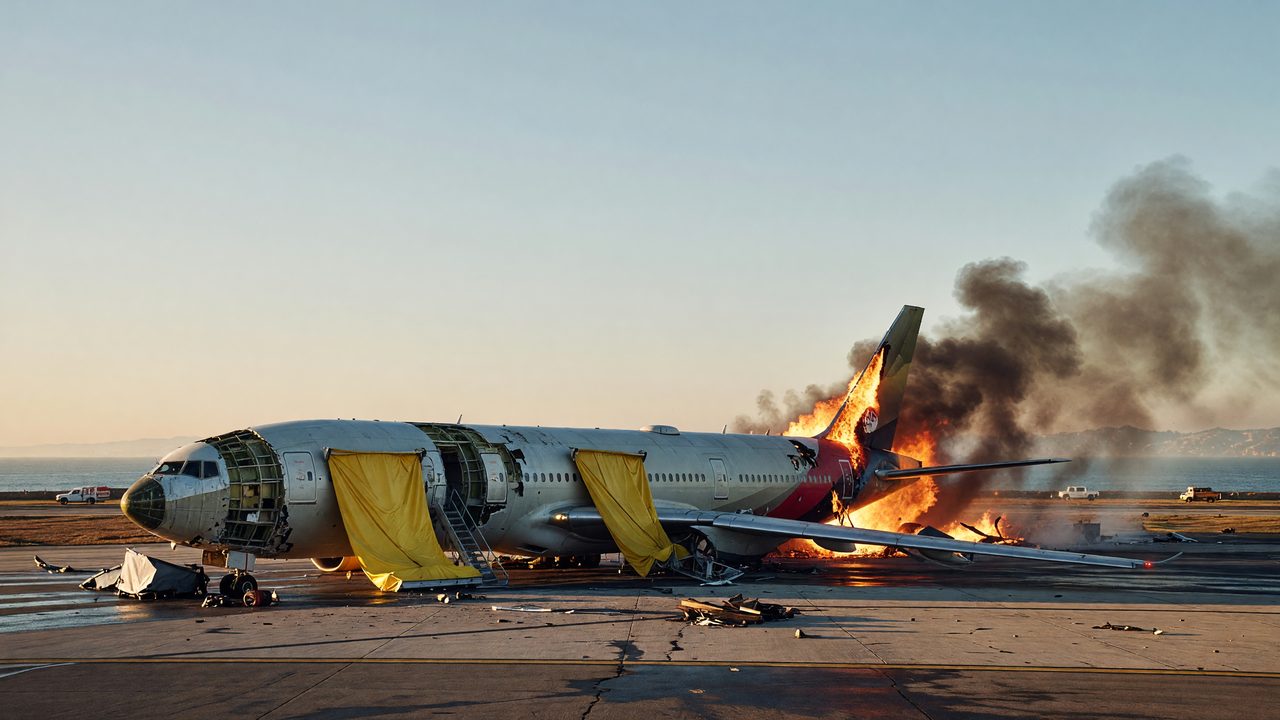
The main landing gear and aft fuselage struck the seawall short of the threshold. The tail separated at the aft pressure bulkhead. The wreckage slid along the runway, lifted, spun roughly three hundred thirty degrees, and struck the ground again. Impact forces destroyed the airframe and inflated slide-rafts inside the cabin. A post-crash fire erupted in the separated right engine resting beside the fuselage. Three passengers died; 187 were injured. Two passengers ejected during the sequence were not belted; the NTSB determined they likely would have survived inside the cabin. Ninety-nine percent of occupants ultimately lived, many through self-evacuation before firefighters reached the burning hull.
The NTSB’s probable cause in Descent Below Visual Glidepath and Impact With Seawall, Asiana Airlines Flight 214 (AAR-14/01) centered on the crew’s mismanagement of the descent, the unintended deactivation of automatic airspeed control, inadequate airspeed monitoring, and a delayed go-around. Contributing factors included autothrottle and autopilot complexity poorly reflected in Boeing documentation and Asiana training, nonstandard crew coordination on autoflight modes, weak supervision of the pilot flying, and fatigue. The Board’s safety recommendations A-14-037 through A-14-051 pressed the FAA, Boeing, and the airline toward clearer mode logic, improved training on visual approaches, and better low-energy alerting — lessons the Flight Safety Foundation later summarized as a lasting case study in how automation can quietly withdraw its protection.
Why it matters to you
The Asiana 214 crew had four pilots in the cockpit and still missed the autothrottle’s shift to HOLD — a mode change that left idle thrust frozen while airspeed unwound on short final. That is not a story about weak pilots; it is a story about monitoring under automation. Every mode selection on a modern jet rewires who is flying: the human, the autopilot, the autothrottle, or some combination that exists only until the next switch, disconnect, or lever movement. When the machine stops watching airspeed, the human must — immediately and aloud. CRM is not merely dividing callouts; it is building a team habit of challenging mode annunciations the way you would challenge a heading bug or altimeter setting. Train for the HOLD trap specifically: idle thrust plus decreasing airspeed on approach is not a minor trend; it is an unstabilized condition demanding a go-around well above five hundred feet, not a last-second save below one hundred. The seawall at San Francisco is gone from the news cycle, but the autoflight logic that put it there is in every glass cockpit you will ever fly. Fly the modes, verify the modes, and never assume the airplane is still doing work it has already handed back to you.